
Pipe Coupling vs Union: What’s the Difference?
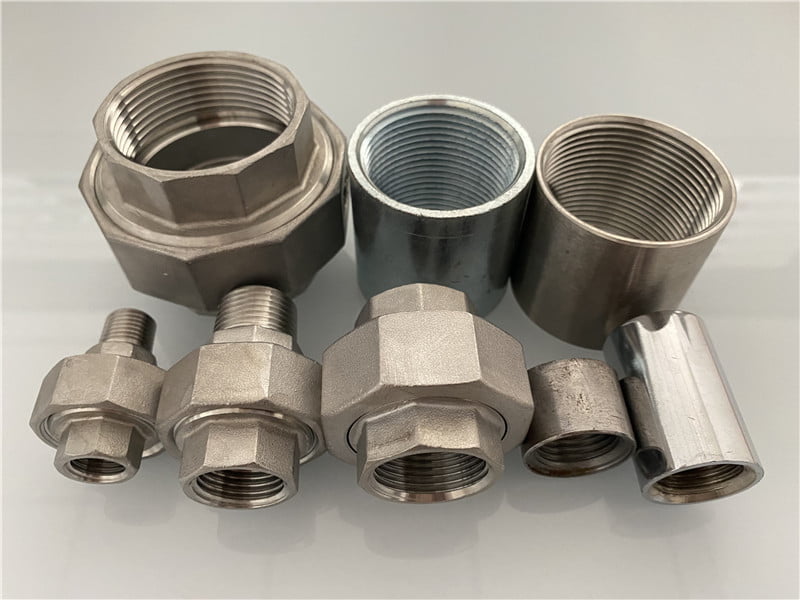
Pipe coupling vs union? When faced with a project, many people are confused about which is more suitable. Both unions and couplings connect piping, while a plumbing union fitting (also called a pipe union fitting) is designed for easy installation with a union nut. A coupling is a short pipe with female threads that extends the pipeline. Couplings provide a strong, permanent connection. Piping unions can be taken apart whenever needed for maintenance or replacement. They are reusable. So, which one should you use? Use a coupling when you need a permanent, fixed connection that won’t be disassembled. Choose a union if disassembly or maintenance is frequent. 1. What is A Pipe Coupling? A pipe coupling, also known as a pipe coupler, is a short piece of pipe used as a connector in plumbing through a threaded connection. The threaded connection is sealed. Couplings are mainly used to extend pipelines when the pipeline is not long enough. We provide couplings ranging from 1/8 inch to 12 inches and can customize them. Plumbing couplings are designed for strength and permanence, making them ideal for applications that are not expected to be frequently removed. Materials Carbon steel: galvanized and black coatings are chosen; stainless steel, PVC, and CPVC. Connection methods Threaded connections, welding, glue. Threaded connections are common and are the easiest. Welding is stronger and more permanent, but not easily removable. Glue is for PVC pipe coupling. Manufacturing standards ASME B1.20.1, DIN 2986, BS 10241. Manufacturing process Plumbing couplings are usually produced by forging. Forged steel couplings provide higher strength for high-pressure applications. Application Pipe couplings are convenient in civil construction, industry, agriculture, and other fields. 2. What Is A Pipe Union? A pipe union fitting (also called a threaded union) is a popular pipe connector because it can be easily installed and disassembled. It mainly consists of three parts: the nut and two tail pieces (top and bottom). Threaded unions are used at the ends of valves, water meters, and other pipelines. A pipe union serves as a convenient disconnect point for maintenance. It is a versatile pipe union fitting. Material Stainless steel threaded unions are common due to applications requiring high-pressure resistance, along with plastics like PVC and malleable iron. Connection forms Threaded is the most common connection; it makes installing and removing the union easier. Socket welding involves inserting a steel pipe into a socket for welding. Threaded unions connect with others through different threads, such as a male thread that connects with a female thread. Therefore, threaded unions are more convenient and are particularly popular for their ease of use in many applications. Manufacturing standards ASME B16.11. Definition A threaded union is a pipe connection by thread, the most common type of pipe fitting. The threaded union simplifies pipeline connections, allowing for easier disassembly and replacement. Type Threaded unions have M×F and F×F threads, which are common types; their two ends have equal diameters. Features of Threaded Union A threaded union is the most versatile type of pipe union, combining quick assembly with reliable sealing. Its threaded design allows direct screw-in connections without welding – ideal for maintenance-prone systems. Key Features of Threaded Pipe Unions and Plumbing Union Fittings Modular Design Consists of three reusable components: female threaded union ends, a central nut, and a sealing surface. Enables disassembly by loosening the nut while keeping pipes stationary (critical for cramped spaces). Standardized Threaded Union Dimensions Follows ASME B16.11 for pressure ratings (Class 2000 to 6000) and ANSI B1.20.1 for thread specs (NPT/BSPP). Common sizes: 1/8 to 4 inches. Plumbing Union Fittings Connection Types: Both ends have internal threads, or one end is female-threaded, and the other is male. 3. Pipe Coupling VS Union Both pipe couplings and pipe unions are pipe fittings. The basic difference between a coupling and a union is that a coupling is a permanent fitting after installation; a piping union can be easily removed at any time. Use couplings to extend pipelines; use unions for components that require frequent maintenance, such as valves and radiators. For larger diameters, flanges are preferred. Plumbing couplings have threaded, butt-welded, and socket couplings, while pipe unions have threaded and socket unions. Unlike couplings, pipe unions can be reused. Pipe unions are suitable for low-pressure applications, while pipe couplings are suitable for high-pressure applications. Where they need to be removed later, use a pipe union; use plumbing couplings where not needed. This is a reason why the ends of valves and water pumps should always use pipe union fittings. 4. Advantages and Disadvantages Couplings are durable, leak-resistant connections for high-pressure systems; once removed, they cannot be reused. Unions can be removed easily, making maintenance and part replacement easy. The connection method provides greater flexibility. However, it is less robust under high pressure or strong vibrations than some fixed connection types. Plumbing Connector Advantages Disadvantages Coupling Simple, compact, strong, cheaper Not conducive to disassembly at any time Union Easy to disconnect and reconnect, ideal for repairs Bulkier, a bit more expensive 5. Industry Applications: Where Are They Used? Both piping couplings and unions are common in various industries, but their specific placement differs. We said threaded couplings cannot be removed easily and reused, but threaded unions can. Use the chart below to determine which fittings are needed. Decision Problems If the Answer is “Yes” Does this place need maintenance later? Union Does it need to connect to valves/pumps/meter? Union Does it only need to extend two pipes? Coupling Is it used in a concealed location, without maintenance later? Coupling Unions are used at the ends of equipment and maintenance interfaces, while couplings are used in piping extensions and concealed solids. Understanding these typical placements helps wholesalers anticipate customer needs based on the type of project they are undertaking. 6. Standards and Compliance Adherence to manufacturing standards is non-negotiable for buyers focused on quality and reliability. Fittings manufactured to standards like ASME B16.11 ensure consistent quality, dimensional accuracy, and specified pressure/temperature ratings. Sourcing from manufacturers who comply with these standards guarantees that the fittings will perform as expected
What Is A Pipe Nipple?
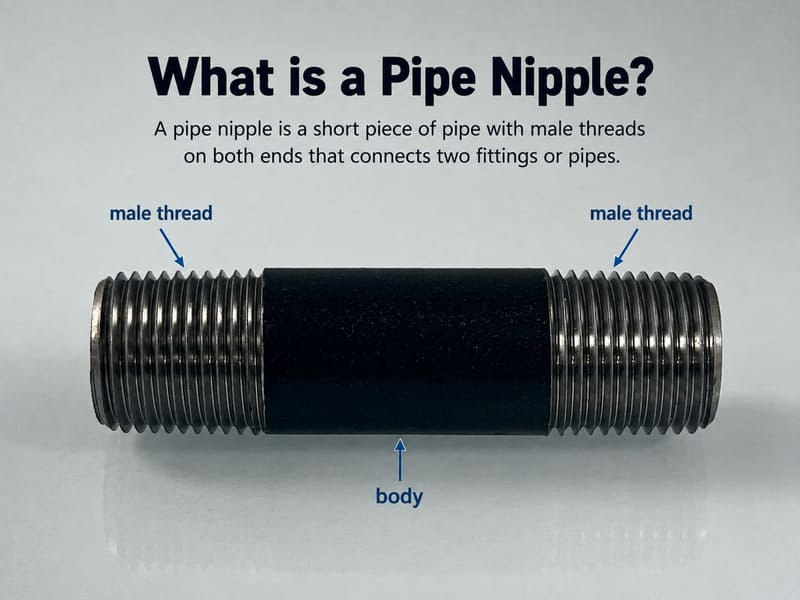
What is a Pipe Nipple? What is a pipe nipple? When talking about this, you will hear many different answers. But you only need to remember this formula: male thread + body + (male thread) = pipe nipple. Why use the parentheses? Because nipple plumbing can be divided into TOE (threaded on one end) and TBE (threaded on both ends). The pipe nipple is a short pipe with external threads (male threads) on both ends or one end, used for connections. Threaded pipe nipples can have NPT or BSP threads. Common types include stainless steel, black carbon steel, and galvanized pipe nipples. As a leading pipe nipple manufacturer, we offer a range of pipe nipples and customized sizes. 1. Types of Pipe Nipples Barrel nipples Usually called a pipe nipple, it is the most common type and has male thread ends and a smooth body in the middle. The smooth body extends the length. Welding nipple It has one end threaded and one end welded. Typically crafted from durable materials like stainless steel or carbon steel, these nipples are often used in high-pressure applications. In industrial settings, the use of welding nipples is prevalent in oil and gas pipelines, chemical plants, and various manufacturing sectors. Seamless pipe nipple In addition to their practical applications in plumbing, seamless pipe nipples are also commonly used in oil and gas industries, chemical processing plants, and HVAC systems. The length of the nipple is typically the total length of its threaded portion. Pipe nipples may have: Reducer (unequal) nipples These fittings connect pipes with differing diameters, ensuring a seamless flow while maintaining pressure integrity. The different-sized ends and threads used on nipples are BSP, BSPT, NPT, NPSM, and Metric. Hex Nipples With a hexagonal section in the middle for wrench use, constructed from robust materials, hex nipples ensure a dependable means of linking two sections of pipe, a secure seal that resists leaks and endures high pressure. Features a hexagonal section in the center, allowing easy tightening or loosening with a wrench. Close Nipple / Running Nipple They have full-body threads, enabling a close connection between two fittings screwed tightly between two female fittings, with very little of the nipple remaining exposed. An internal pipe wrench prevents thread damage. Hose Nipple There is a special style of pipe nipple called a hose nipple for connecting threaded pipes and smooth hoses. One end of the nipple has an external thread, while the other is a hose barb. The hose barb size can match the pipe connection size or be reduced properly. King nipple The king nipple has a special design: one end is a threaded connection to other female threads, and the other is a barb end to connect a hose pipe. 2. Supply Range for Pipe Nipples The working pressure of pipe nipples will vary with the size and construction of the pipe, the type and number of clamps used, clamp placement, correct clamp installation, temperature, and the product being conveyed. Pipe nipples are available in the widest variety of wall thicknesses and materials. Hebei Sanvo, a trusted supplier, offers threaded pipe nipples and seamless pipe nipples in carbon steel and stainless steel. Material Carbon steel, Stainless steel Standards ASTM A733, DIN2982, BS EN10241 Dimensions 1/8″-8″ (DN6-DN150) Finishes Black or galvanized 3. How to Install Pipe Nipple? Before, we learned about pipe nipple types, and now, we will talk about how to install them. It is not difficult; regardless of the type, the installation methods are almost the same. Tighten the thread in a clockwise direction (except for a very few types), Screw by hand first, then use a wrench or spanner to tighten it further. Note that a closed nipple requires an internal expansion wrench due to its design; the welding nipple has a welding end for welding to others. 4. Pipe Nipple Standards Hebei Sanvo exports various standards of steel pipe nipples, including carbon steel pipe nipples, stainless steel pipe nipples, welded pipe nipples, seamless pipe nipples, American standard steel pipe nipples, German standard steel pipe nipples, British standard steel pipe nipples, etc. ASTM A733 Standard Carbon Steel Pipe Nipple Material: ASTM A53/A106 Thread: ANSI/ASME B 1.20.1 Stainless Steel Pipe Nipple Material: ASTM A312 (304/316); welded or seamless Thread: ANSI/ASME B 1.20.1 DIN2982, BS EN10241 Standards DIN2982 Material: DIN2441 or DIN2440 seamless/welded pipe Thread: DIN259; DIN2999 BS EN10241 Material: BS1387 seamless or welded pipe Thread: ISO 7/1 or BS 21 5. Dimension Standards The pipe nipple has different dimension standards according to different thread manufacturing standards. Different thread types. The most commonly used types are NPT threads and BSP Threads. NPT is an American standard for tapered threads, whereas BSP is a British standard for threads. The BSP thread includes two types: the tapered BSPT and the parallel BSPP. NPT Pipe Nipple Dimension Standard BSP Pipe Nipple Dimension Standard 6. Materials Carbon nipple Carbon steel nipples usually include galvanized and black steel nipples. These are used to connect two other pipes or fittings, offering a reliable and durable solution for fluid transfer. Galvanized nipple The galvanization process, which involves coating steel with a layer of zinc, provides enhanced corrosion resistance, making these nipples ideal for use in environments prone to moisture and chemical exposure. Black pipe nipple A black pipe nipple without coating. Not resistant to corrosion and wear. Stainless nipple When selecting the stainless steel grade for your pipe nipples, it is crucial to consider factors such as the specific environment, pressure ratings, and temperature variations. Common grades like 304 and 316 are popular due to their excellent mechanical properties. 7. Material Grades of Steel Pipe Nipples Pipe nipples by Hebei Sanvo have high-quality materials: Carbon Steel ASTM A105, ASTM A53 GR. A & B, API 5L GR. B Stainless Steel ASTM A182 (304, 316), ASTM A312/A403 (TP304, TP316) Hebei Sanvo Pipes And Fittings Co., Ltd. is in Cangzhou City, Hebei Province, China. Hebei Sanvo is a Chinese manufacturer. It was engaged in producing and researching pipe nipples, pipe couplings, and stainless steel pipe
Pipe Bushing vs Reducing Coupling: What’s The Difference?
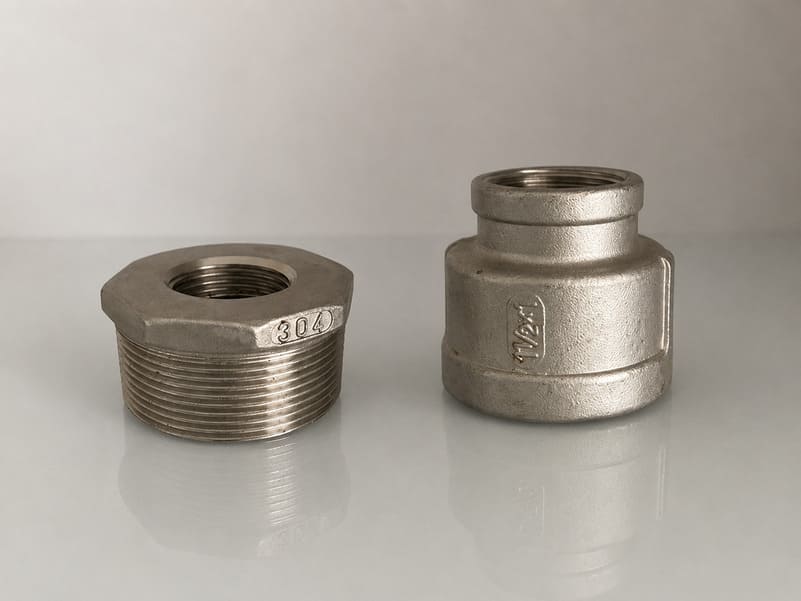
Purchasers often confuse pipe bushings and pipe reducers when buying products from us. Yes, in their function, they are similar. And they are pipe reducer fittings. The best way to distinguish them is still by appearance. A bushing has threaded ends, and a pipe reducer has plain ends. A pipe bushing normally has a male thread on the outside and a female thread on the inside, allowing it to reduce a threaded opening while maintaining a compact connection. What Is A Pipe Bushing? The pipe bushing has one male end and one female threaded end. Usually, the larger diameter is the male threaded end. Its core role is to let a large female end convert to a smaller male end. What Is A Hex Bushing? The hex bushing is a common type of bushing. What we often refer to as a pipe bushing actually means a hex bushing. A hex bushing has a hex part as the main body. So, if a product is short, has a hex part, one male end, and one female threaded end. It can basically be directly judged as a hex bushing. What Is A Pipe Reducer? The primary function of a pipe reducer is to connect pipes of varying diameters. Both ends are usually weld or socket ends. The shape of a pipe reducer looks like a trumpet. Usually, a pipe reducer is longer than a hex bushing and without a hex part. Its main role is to reduce the fluid from a large diameter to a small diameter. What is a Reducing Coupling? The reducer coupling is a type of reducer pipe fitting that has threaded ends. Reducer couplings have female threaded ends. Reducer couplings connect pipes and fittings of different sizes. Reducer Coupling & Standard Pipe Coupling Normal pipe couplings and reducer couplings have female threads. But standard pipe couplings have the same diameter, whereas reducer couplings do not. Bushing vs Reducer: Main Differences Feature Pipe Bushing Pipe Reducer Main Purpose Reduce a threaded connection Transition between different pipe sizes Typical Design Male × Female Various configurations Common Connection Threaded Threaded or welded Shape Compact Tapered or concentric Installation Usually threaded Threaded or welded Common Application Small threaded connections Industrial pipe transitions The most important distinction is that a threaded bushing changes the size of a threaded opening, while a reducer is primarily designed to create a transition between different pipe sizes. Common Purchasing Mistakes Choosing Only By Nominal Size A fitting cannot be selected based only on the two connection sizes. Always confirm: Male/female configuration Thread standard Material Connection type Assuming All Reducing Fittings Are Bushings A bushing is only one type of reducing fitting. Reducers, reducing tees, reducing couplings, and other fittings can also change connection sizes. The correct product depends on the function of the connection. Mixing Thread Standards NPT, BSPT, and BSPP should not be treated as interchangeable simply because their nominal sizes appear similar. Always confirm the required standard before production. Conclusion Bushings and reducer couplings both connect different diameters. But their designs are different. Yes, although the hex bushing and reducer coupling connect a big diameter to a small one. They have different installation environments and connection requirements. Reducer couplings are connected to two different-sized male threaded pipe fittings. Actually, it is a pipe coupling, just converted to a reducer connection. Hex bushings connect a big female end with a small male end. The correct fitting can make installation and maintenance much easier. FAQ What is the main difference between a pipe bushing and a reducer? A bushing adapts a larger female-threaded connection to a smaller threaded connection. Its hex body provides a surface for a wrench during installation. What is a hex bushing used for? A bushing adapts a larger female-threaded connection to a smaller threaded connection. Its hex body provides a surface for a wrench during installation. Is a pipe bushing a type of reducer? Yes, but its specific male-to-female threaded connection is not interchangeable with every reducer type. Can NPT and BSP bushings be connected together? They cannot be directly mixed. They have different thread profiles and specifications, so confirm the thread before ordering. Which is better, a bushing or a reducer? Neither is universally better. A bushing is for compact threaded connections. A reducer is more suitable when transitioning between different pipe sizes.
Pipe Elbow Types: Welded & Threaded Elbow Guide
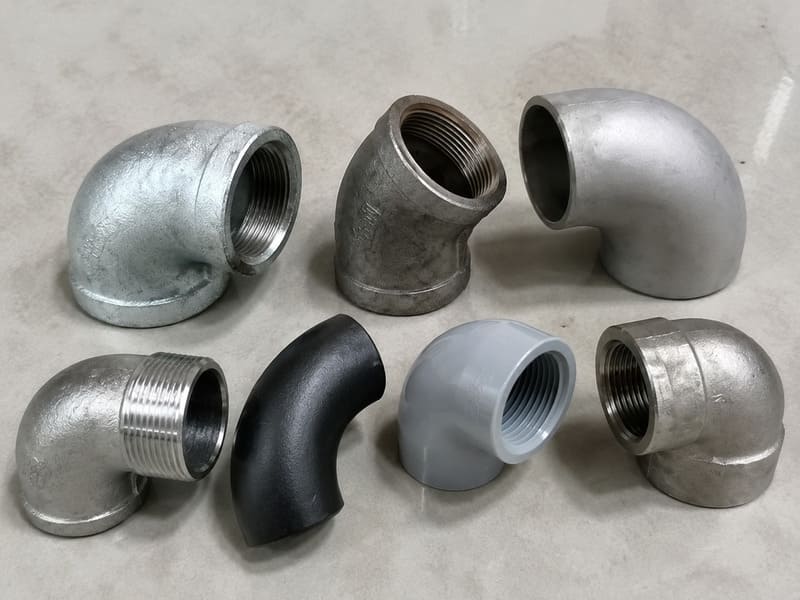
This guide provides all the information about pipe elbows, including types, pressure grades, angles, and connection methods. To distinguish between welded and threaded pipe elbows, I will introduce 3 types of welded elbows and multiple types of threaded elbows. First, let me introduce myself. We are a manufacturer with our own factory. Our main product lines include pipe nipples, couplings, and a series of stainless steel pipe fittings. We can also customize products according to your drawings and requirements. Welcome to contact us if you have any related needs. OK, let’s get started! Threaded Elbow Threaded elbow, as its name suggests, is a pipe elbow with threads on the ends to connect with other threaded pipe fittings without welding. 2 Technologies of Threaded Elbows Forged Threaded Elbow Forged threaded elbows are manufactured using forging technology. They usually have Class 2000, Class 3000, and Class 6000 pressure grades. They feature thicker wall thickness and reinforced ends. Casting Elbow Casting elbows are manufactured by casting. Normal pressure grades include 150Lb and 125Lb, with standard wall thickness. 4 Angles of Elbows 90 Degree Elbow A 90-degree elbow is the most common type. It changes the pipeline direction by 90 degrees. 45 Degree Elbow A 45-degree elbow creates less resistance to fluid flow compared with a 90-degree elbow. 60 Degree and 180 Degree Elbow 60-degree and 180-degree elbows are not commonly used in normal piping systems. 4 Thread Types NPT NPT is a tapered thread. The tighter it is tightened, the better the sealing effect. It is commonly used in American standard piping systems. BSPT BSPT is also a tapered thread. It is commonly used in Europe and Asia. It is not universally compatible with NPT threads. BSPP BSPP is a parallel thread. Sealing usually requires a gasket or sealing washer. NPS (National Pipe Straight) NPS is a parallel thread and is rarely used alone in elbow applications. Different Female and Male Threaded Elbows Female Elbow A female elbow has female threads on both ends. It is the most common type. Male Elbow A male elbow has male threads on both ends. It is less common and usually used for special applications. Street Elbow A street elbow has one male end and one female threaded end. The male end can be directly inserted into another female threaded fitting without requiring an additional threaded fitting. It is commonly used where installation space is limited. Special Type Reducing Elbow A reducing elbow has two different sizes on both ends. It changes the pipeline direction while also reducing or increasing the pipe diameter. Types of Welded Elbows Butt Weld Elbow A butt weld elbow, also called a welded pipe elbow, has beveled ends on both sides and a smooth welded body. It provides smooth fluid flow, higher sanitary performance, high strength, and resistance to high pressure and high temperature. It is commonly used for large nominal pipe sizes. Socket Weld Elbow The end of a socket weld elbow is similar to the rim of a cup, where the pipe is inserted into the socket and welded. It provides fast and easy installation and is suitable for high-pressure piping systems with small nominal sizes. Socket weld elbows use an insertion connection and are suitable for smaller nominal sizes because they are quick and easy to weld. Butt weld elbows use end-to-end welding and are suitable for large nominal sizes, high pressure, high temperature, and applications with higher sanitary requirements. Flanged Elbow The body of a flanged elbow is similar to a butt weld elbow, except that it has two flanges on both ends. A flanged elbow does not require welding. Instead, it connects and seals through bolts and gaskets. The biggest advantage is that it can be removed easily without cutting the pipeline. It is convenient for applications that require frequent replacement and maintenance. Type Connection Method Removal Socket Weld Pipes are inserted into the ends of elbows and welded. Cannot be removed. The connection is sealed and requires cutting for removal. Butt Weld Elbows and pipes are aligned and welded from end to end. Cannot be removed. The connection is sealed and requires cutting for removal. Flanged Two flange pieces are connected with the elbow in the middle and locked with bolts. Can be removed easily by simply loosening the bolts.
ERW vs Seamless Pipe: What’s The Difference?
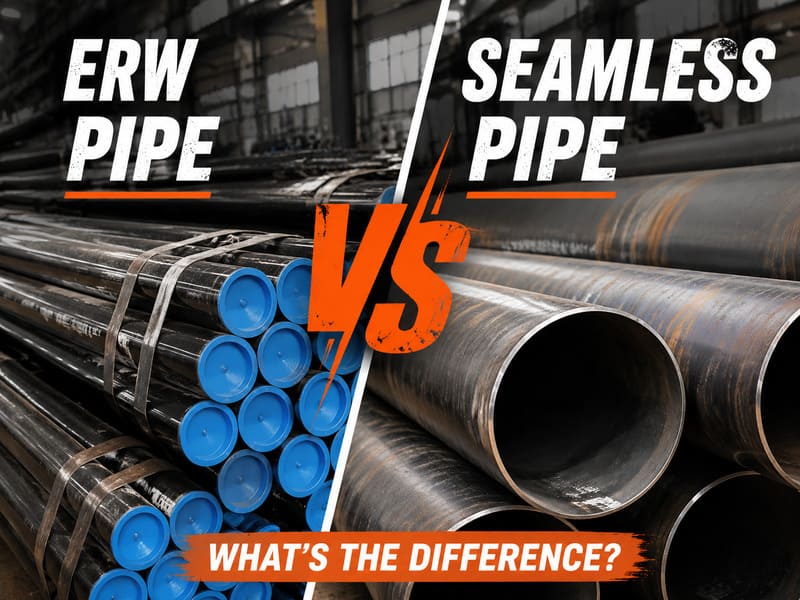
When purchasing steel pipes, buyers often need to compare ERW vs seamless pipe. They have similar functions, but their manufacturing processes, features, and applications are different. Selecting the wrong pipe type may increase costs or result in unsuitable performance. For example, a general water pipeline may not require seamless pipe, while high-pressure and high-temperature applications may require seamless construction. We supply steel pipes, including material grade, manufacturing process, standards, and application conditions. This guide explains the key differences between ERW pipe vs seamless pipe to help buyers. What Is ERW Steel Pipe? ERW stands for Electric Resistance Welded pipe. Flat steel is formed into a round shape and joined via electrical resistance welding. The main production steps include: Steel coil preparation Roll forming Edge heating Electric resistance welding Inspection and finishing Because ERW production uses automated welding technology, it provides: Consistent dimensions High production efficiency Competitive pricing ERW steel pipes are widely used in: Water transportation Fire sprinkler systems Structural applications Mechanical piping General industrial systems What Is Seamless Steel Pipe? Seamless steel pipe is manufactured without a welded seam. Seamless steel pipe is produced from solid billets rather than welded plates. The manufacturing process typically includes: Billet heating Piercing Rolling Sizing Heat treatment Inspection Seamless pipes excel in demanding environments without welded joints. Common applications include: Oil and gas systems High-pressure pipelines Boilers Power plants Chemical processing equipment ERW vs Seamless Pipe: Main Differences Feature ERW Pipe Seamless Pipe Manufacturing Welded from steel strip Made from solid billet Weld Seam Present No weld seam Production Cost Lower Higher Dimensional Accuracy Excellent Excellent Pressure Capability Suitable for many applications Better for extreme conditions Production Efficiency Higher Lower Common Use General industrial piping High-pressure applications Manufacturing Process Comparison ERW Pipe Production ERW manufacturing is highly efficient because steel coils can be continuously processed. Advantages: Fast production speed Lower material waste Competitive pricing Suitable for large-volume orders Modern ERW technology provides excellent weld quality through: Automatic control systems Non-destructive testing Dimensional inspection Seamless Pipe Production Seamless manufacturing requires more complex processing. The billet must be heated and pierced before being rolled into a hollow pipe. Advantages: Uniform structure Excellent pressure resistance Suitable for extreme environments However, the manufacturing process requires more equipment and energy, resulting in higher production costs. Strength Comparison: Is Seamless Always Stronger? Many buyers assume seamless pipe is always stronger than ERW pipe. This is not always correct. Modern ERW pipes can achieve excellent mechanical performance when manufactured according to proper standards and quality controls. The actual performance depends on: Material grade Wall thickness Manufacturing standard Inspection requirements Application conditions For normal industrial applications, high-quality ERW pipe can provide reliable performance. For high-temperature or high-pressure applications, seamless pipe is often preferred. Application Comparison ERW Steel Pipe Applications Common uses: Fire protection systems Water pipelines HVAC systems Mechanical structures General industrial piping ERW is often selected because it provides a good balance between: Performance Availability Cost Seamless Steel Pipe Applications Common uses: Oil and gas industry Pressure vessels Chemical processing Power generation These industries require pipes capable of handling: High pressure High temperature Continuous operation Cost Difference Between ERW And Seamless Pipe Cost is one of the most important factors for buyers. Generally: ERW pipe is more economical. Reasons include: Higher production efficiency Lower manufacturing cost Better material utilization Seamless pipe costs more because: Production is more complex Equipment investment is higher Manufacturing cycle is longer However, selecting based only on price may create problems. The correct choice should consider: Operating conditions Safety requirements Long-term maintenance cost How To Choose Between ERW And Seamless Pipe? Choose ERW pipe when: The application is general industrial use Cost efficiency is important Pressure requirements are moderate Large quantities are required Choose seamless pipe when: High pressure is involved High temperature service is required Critical industrial applications are involved Before ordering, buyers should confirm: Pipe standard Material grade Wall thickness Application requirements Relationship Between Steel Pipes And Pipe Fittings A complete piping system requires compatibility between pipes and fittings. For example: A carbon steel piping system may include: ERW or seamless pipe Pipe nipples Couplings Elbows Flanges Valves The selected components should match in: Material Pressure rating Connection method Applicable standards SANVO Manufacturing Capability As a manufacturer of steel pipes and pipe fittings, SANVO provides solutions for different industrial applications. Our production capability covers: Carbon steel pipes Galvanized steel pipes Threaded pipe fittings Pipe nipples Pipe couplings We help customers select suitable products according to: Application requirements International standards Project specifications Conclusion ERW and seamless steel pipes are both important products used in piping systems. ERW pipes are economical, while seamless pipes suit high-pressure and high-temperature environments. Understanding the differences in their manufacturing processes helps select the correct pipe and decrease costs.
ASTM A53 vs ASTM A106 Pipe: What’s The Difference?
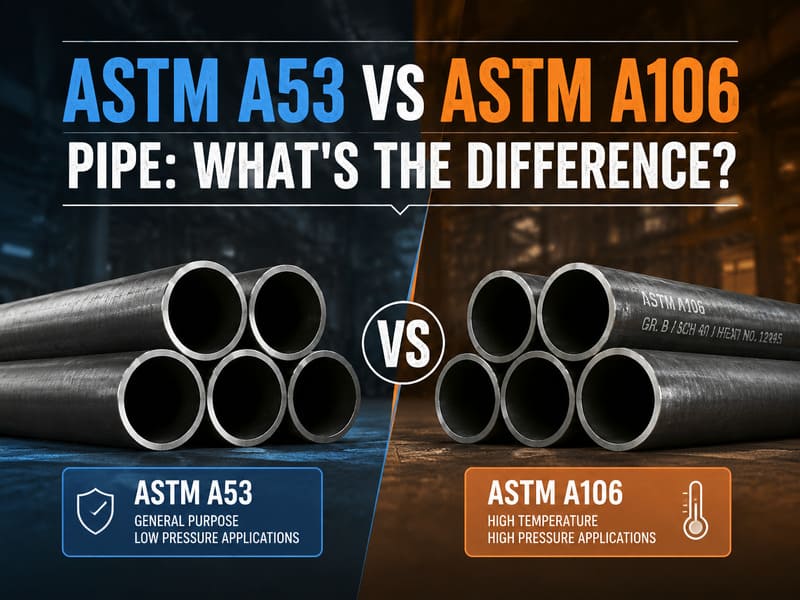
When purchasing carbon steel pipes for industrial projects, ASTM A53 vs A106 are two of the most commonly used standards. Although these two standards are often compared because they are both used for carbon steel piping systems, they are designed for different applications. Many buyers mistakenly select pipes only based on size and price, while overlooking factors such as: Temperature requirements Pressure conditions Manufacturing process Application environment Choosing the wrong specification may result in unsuitable performance or unnecessary project costs. As a manufacturer supplying steel pipes and pipe fittings for international markets, SANVO works with customers who require different ASTM pipe standards depending on project requirements. This article explains the differences between ASTM A53 and ASTM A106 and helps buyers understand which pipe is more suitable for their applications. What Is ASTM A53 Pipe? ASTM A53 is a standard specification for carbon steel pipe used mainly in mechanical and pressure applications. It covers: Welded pipe Seamless pipe Black steel pipe Galvanized steel pipe ASTM A53 steel pipe is widely used in: Water pipelines Plumbing systems Fire sprinkler systems Mechanical applications Structural applications Because of its versatility and relatively economical cost, ASTM A53 is one of the most commonly used carbon steel pipe standards. What Is ASTM A106 Pipe? ASTM A106 is a specification for seamless steel pipe designed for high-temperature service. It is commonly used in industries requiring: High pressure resistance Elevated temperature performance Continuous operation Typical applications include: Oil and gas facilities Power plants Refineries Industrial processing systems ASTM A106 seamless carbon steel pipe, whose construction provides better performance under demanding temperature and pressure conditions. ASTM A53 vs A106: Main Differences Feature ASTM A53 ASTM A106 Main Purpose General pressure and mechanical applications High-temperature service Manufacturing Welded and seamless Mainly seamless Application Level General industrial use Heavy-duty industrial systems Temperature Resistance Standard Higher Cost More economical Higher Common Industries Construction, water, fire protection Oil, gas, power generation Manufacturing Process Difference One of the biggest differences between ASTM A53 and A106 is manufacturing. ASTM A53 Can be produced through: ERW welding Seamless process ERW (Electric Resistance Welding) pipe is commonly used when cost efficiency is important. ASTM A106 Normally produced as: Seamless pipe The seamless process eliminates the welded seam, making it suitable for higher temperature and pressure applications. Chemical Composition And Mechanical Requirements Both standards control: Carbon content Tensile strength Yield strength However, ASTM A106 generally has stricter requirements because it is designed for more demanding environments. When selecting between the two standards, buyers should consider not only chemical composition but also: Working temperature Pressure rating Service conditions ASTM A53 vs A106: Which One Should You Choose? Choose ASTM A53 when your project requires: Water transportation Fire sprinkler systems General mechanical piping Cost-effective solutions Choose ASTM A106 when your project requires: High-temperature operation High-pressure service Industrial processing Energy applications The correct choice depends on the actual working environment rather than simply choosing the higher-grade material. Relationship Between Pipe Standards And Pipe Fittings When designing a piping system, pipes and fittings should be compatible. For example: A carbon steel pipe system may require: ASTM pipe specification Matching threaded fittings Suitable pressure rating Compatible connection method Pipe nipples, couplings, elbows, and other fittings should meet the project requirements to ensure system reliability. How Manufacturers Ensure Quality Professional manufacturers control quality through: Raw material inspection Chemical composition testing Mechanical testing Dimensional inspection Surface inspection For export projects, documentation such as: Mill Test Certificates Inspection reports may also be required. Conclusion ASTM A53 and ASTM A106 are both important carbon steel pipe standards, but they serve different purposes. ASTM A53 is commonly used for general mechanical, water, and fire protection applications, while ASTM A106 is designed for higher temperature and more demanding industrial environments. Understanding these differences helps buyers select the correct pipe specification, reduce purchasing risks, and ensure reliable piping system performance.