
Hot-Dip Galvanized vs Electro-Galvanized Pipe Fittings: What’s the Difference?
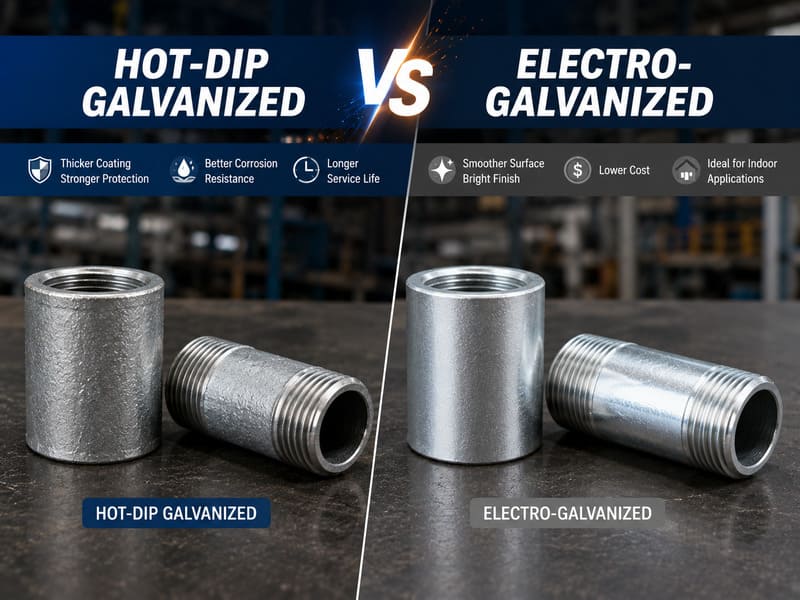
Galvanized pipe fittings are widely used in water supply, fire protection, construction, and industrial piping because the zinc coating helps protect steel from corrosion. However, not all galvanized fittings are manufactured in the same way. The two most common galvanizing methods are hot-dip galvanizing and electro-galvanizing. While both create a protective zinc layer, they differ in coating thickness, durability, appearance, and cost. As a manufacturer of threaded pipe nipples and pipe couplings, we are frequently asked which galvanizing process is better for specific applications. The answer depends on the operating environment and the expected service life of the piping system. This guide explains the differences between these two processes and helps buyers choose the most suitable option. What Is Hot-Dip Galvanizing? Hot-dip galvanizing is a process in which cleaned steel fittings are immersed in molten zinc at approximately 450°C (842°F). The molten zinc reacts with the steel surface, forming several zinc-iron alloy layers and an outer zinc coating. Because the coating becomes metallurgically bonded to the steel, it offers excellent protection against corrosion and mechanical damage. Hot-dip galvanized pipe fittings are commonly used in: Outdoor pipelines Fire sprinkler systems Water supply projects Agricultural irrigation Industrial facilities Coastal environments One of the biggest advantages of hot-dip galvanizing is its long service life, especially in harsh environments where moisture and chemicals accelerate corrosion. What Is Electro-Galvanizing? Electro-galvanizing, also known as electrolytic galvanizing, uses an electric current to deposit a thin layer of zinc onto the steel surface. Unlike hot-dip galvanizing, the zinc layer is much thinner and does not form the same alloy structure with the base metal. Electro-galvanized fittings usually have: A smoother surface finish A brighter appearance Better dimensional consistency for decorative applications However, because the zinc coating is thinner, corrosion resistance is generally lower than that of hot-dip galvanized products. Electro-galvanized fittings are often selected for indoor environments where exposure to moisture is limited. Hot-Dip vs Electro-Galvanized: Key Differences Feature Hot-Dip Galvanized Electro-Galvanized Coating Process Molten zinc immersion Electroplating Zinc Coating Thick Thin Corrosion Resistance Excellent Moderate Surface Finish Slightly rough Smooth and bright Outdoor Use Recommended Limited Indoor Use Suitable Suitable Service Life Longer Shorter Cost Higher Lower Although electro-galvanized fittings may have a cleaner appearance, hot-dip galvanized fittings are generally preferred for demanding industrial applications because they provide stronger long-term protection. Which One Should You Choose? The choice depends on your project requirements. Choose hot-dip galvanized fittings if you need: Long-term corrosion resistance Outdoor installation Fire protection systems Industrial or municipal projects Coastal or humid environments Choose electro-galvanized fittings if you need: Lower initial cost Indoor installation Decorative appearance Light-duty applications For most industrial buyers, durability and maintenance costs are more important than the initial purchase price. In these situations, hot-dip galvanized pipe fittings often provide better long-term value. Our Manufacturing Experience At SANVO, galvanized pipe nipples and pipe couplings are produced according to customer specifications, including material grade, thread standard, and surface treatment. Before galvanizing, each fitting undergoes machining and thread inspection to ensure dimensional accuracy. After coating, the fittings are visually inspected to verify coating quality and thread integrity before packaging. This controlled manufacturing process helps ensure consistent product performance across different export markets. Conclusion Both hot-dip galvanized and electro-galvanized pipe fittings offer corrosion protection, but they are designed for different operating environments. If your project requires maximum durability and long-term performance, hot-dip galvanizing is generally the preferred choice. For indoor or light-duty applications where appearance and cost are more important, electro-galvanized fittings may be sufficient. Understanding the differences between these two galvanizing methods helps buyers select the most appropriate fittings and reduce maintenance costs over the life of the piping system. FAQ Is hot-dip galvanizing better than electro-galvanizing? For most outdoor and industrial applications, yes. Hot-dip galvanizing provides a thicker zinc coating and significantly better corrosion resistance. Can electro-galvanized fittings be used outdoors? They can be used in mild outdoor conditions, but their thinner zinc coating generally results in a shorter service life than hot-dip galvanized fittings. Which galvanized fittings are commonly used in fire sprinkler systems? Hot-dip galvanized threaded pipe nipples and couplings are commonly specified because of their durability and corrosion resistance. Do galvanized fittings require additional painting? In most cases, no. The zinc coating itself provides effective corrosion protection without the need for additional surface treatment.
Pipe Coupling vs Pipe Nipple: Key Differences and How to Choose
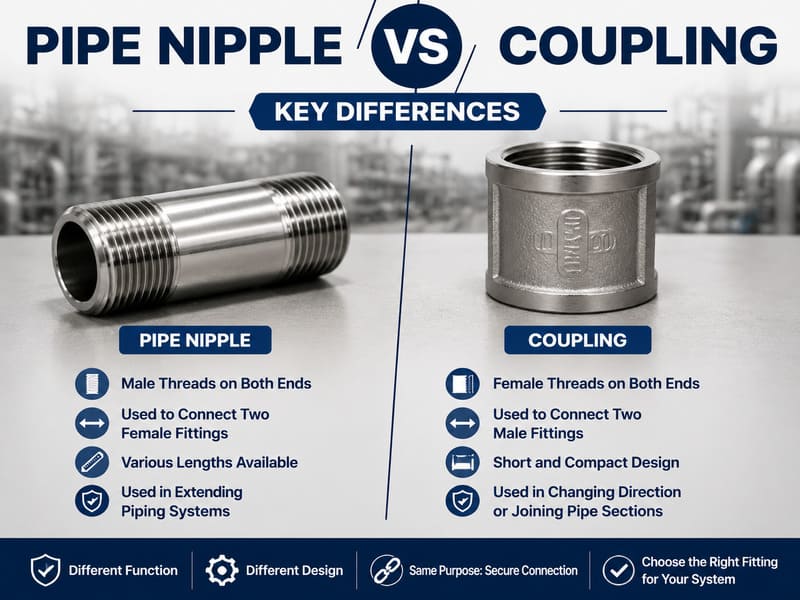
Introduction One of the most common questions we receive from distributors, contractors, and industrial buyers is: “Should I use a pipe coupling or a pipe nipple?” Although these two threaded fittings are often installed together in the same piping system, they are designed for different purposes. Choosing the wrong fitting may lead to unnecessary adapters, additional labor, leakage risks, or even an incompatible piping assembly. Many purchasing mistakes for pipe couplings and nipples occur because buyers focus solely on thread size, neglecting the fitting’s actual function. This guide explains the practical differences between pipe couplings and nipples, compares their applications, and provides recommendations that can help buyers make better purchasing decisions. Pipe Coupling at a Glance A pipe coupling is a female-threaded fitting used to connect two male-threaded pipes or fittings. Unlike a pipe nipple, a coupling does not extend the pipeline. Instead, it joins two externally threaded components into a continuous connection. Because of its simple structure, the coupling is widely used in residential plumbing, fire protection systems, industrial piping, compressed air systems, and mechanical installations. Typical materials include: Carbon steel Galvanized carbon steel Stainless steel Brass Depending on the project, couplings may be supplied as: Full Coupling Half Coupling Reducing Coupling Socket Coupling Industrial buyers usually specify the material grade, thread standard, pressure requirement, and surface finish before placing an order. Pipe Nipple at a Glance A pipe nipple is a male-threaded section of pipe with threads on one or both ends. Instead of connecting two male threads together, a pipe nipple extends or connects piping by engaging with female-threaded fittings such as couplings, elbows, tees, valves, or unions. Pipe nipples are available in numerous lengths and configurations, including: Close Nipple Barrel Nipple Hex Nipple Weld Nipple Shoulder Nipple Hose Nipple TBE (Thread Both Ends) Nipple Material options are generally the same as pipe couplings, but pipe nipples offer much greater flexibility in terms of length and customization. For export projects, custom lengths are frequently manufactured according to engineering drawings or project specifications. Pipe Coupling vs Pipe Nipple: Understanding the Fundamental Difference Although these fittings are often installed together, they perform different functions within a piping system. The easiest way to understand the difference is to think about how they interact with pipe threads. A coupling receives threads internally. A pipe nipple provides threads externally. This simple distinction determines where each fitting can be used. For example: Imagine two threaded steel pipes that need to be joined together. Since both pipes already have external threads, another externally threaded fitting cannot connect them. Instead, a female-threaded coupling is required. Now consider a threaded valve that needs to be installed several inches away from a pipe elbow. A short pipe nipple is installed between the two fittings to provide the required extension. Although both components are threaded fittings, they solve completely different installation problems. Comparison Table Feature Pipe Coupling Pipe Nipple Thread Type Female Thread Male Thread Primary Function Connect Two Male Threads Extend or Connect Threaded Components Standard Length Very Short Various Lengths Available Thread Position Internal External Common Materials Carbon Steel, Galvanized Steel, Stainless Steel Carbon Steel, Stainless Steel, Brass Custom Length Rare Very Common Installation Purpose Joining Pipes Extending Pipe Connections Used With Male Threaded Pipes Female Threaded Fittings For buyers unfamiliar with threaded fittings, this comparison provides a quick reference when reviewing product catalogs or preparing procurement lists. Where Is a Pipe Coupling Used? Pipe couplings are commonly selected when two externally threaded pipes or fittings must be joined securely. Typical applications include: Commercial plumbing systems Water distribution pipelines Fire sprinkler installations Compressed air systems Irrigation networks Industrial utility piping Because couplings have no extended body, they occupy minimal installation space and provide a compact threaded connection. In maintenance projects, replacing a damaged coupling is usually faster than replacing an entire section of pipe, making it a cost-effective fitting for repair work. Where Is a Pipe Nipple Used? Pipe nipples are selected whenever additional threaded length is required between fittings. Common examples include: Connecting valves to pipelines Extending threaded outlets Pressure gauge installations Pump connections Boiler systems Gas piping Hydraulic equipment Chemical process piping Unlike couplings, pipe nipples are available in many standard and custom lengths, allowing engineers to achieve precise spacing between connected components. For this reason, distributors often stock multiple nipple lengths while keeping fewer coupling variations in inventory. Material Comparison: Does the Material Matter More Than the Fitting Type? When comparing a pipe coupling with a pipe nipple, many buyers focus on the fitting type first. In reality, the material often has a greater impact on long-term performance than whether the fitting is a coupling or a nipple. The correct material should always be selected according to the operating environment rather than simply matching the existing pipeline. Carbon Steel Carbon steel is one of the most widely used materials for threaded pipe fittings because it offers high mechanical strength and an economical cost. It is commonly used in: Compressed air systems Mechanical equipment Oil and gas pipelines Industrial machinery Structural piping However, untreated carbon steel is susceptible to corrosion in humid or outdoor environments. Galvanized Carbon Steel Galvanized fittings are carbon steel products coated with zinc to improve corrosion resistance. Galvanized pipe nipples and couplings are widely used in: Water supply systems Fire sprinkler systems Outdoor installations Agricultural irrigation HVAC piping Although galvanized fittings cost slightly more than black steel fittings, the additional corrosion protection often results in a longer service life and reduced maintenance. Stainless Steel Stainless steel provides the highest level of corrosion resistance among commonly used threaded fitting materials. Typical applications include: Food processing Pharmaceutical plants Marine environments Chemical processing High-humidity facilities Grades such as 304, 304L, 316, and 316L are selected according to corrosion requirements and project specifications. Although stainless steel fittings are more expensive, they are often the most economical choice over the lifetime of the system because of their durability and reduced maintenance. Brass Brass pipe nipples and couplings are frequently used where corrosion resistance and
How Pipe Nipples Are Manufactured: From Cutting To Threading
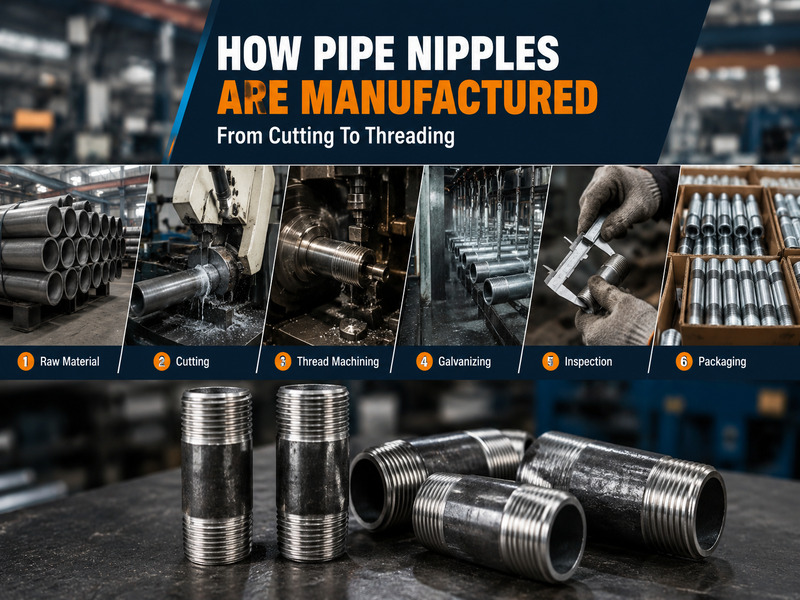
Introduction When purchasing pipe nipples for industrial applications, many buyers focus on material, size, and thread standards. However, the manufacturing process behind a pipe nipple directly affects its dimensional accuracy, sealing performance, and service life. As a pipe nipple manufacturer, we produce threaded pipe nipples for distributors, contractors, and industrial customers worldwide. From raw material selection to final inspection, every production step plays an important role in ensuring consistent quality. This article explains how pipe nipples are manufactured, including cutting, thread machining, surface treatment, inspection, and packaging. 1. Raw Material Selection For Pipe Nipple Production The manufacturing process starts with selecting suitable steel pipes according to customer requirements. Common materials include: Carbon steel Galvanized carbon steel Stainless steel Brass For industrial applications, manufacturers usually select materials according to: Working environment Corrosion resistance requirements Pressure requirements Temperature conditions Thread standard For example: Galvanized steel pipe nipples are commonly used in applications requiring additional corrosion protection, while stainless steel pipe nipples are preferred in environments involving chemicals, moisture, or food processing. 2. Steel Pipe Cutting: Preparing The Correct Length After selecting the raw pipe, the first production step is cutting. Pipe nipples are normally manufactured according to: Customer drawings Standard dimensions Thread requirements During cutting, manufacturers must control: Cutting length accuracy End face flatness Pipe deformation Incorrect cutting may affect the following threading process and result in poor installation performance. For standard products, pipe nipple lengths are usually produced according to commonly requested sizes. Customized lengths can also be manufactured based on project requirements. 3. End Preparation Before Threading Before thread machining, the pipe ends require preparation. This process may include: Removing burrs Cleaning pipe ends Adjusting end surface condition A smooth pipe end helps ensure: Better thread formation Improved sealing performance Reduced installation problems For threaded fittings, even small dimensional errors can affect connection quality. 4. CNC Thread Machining: The Key Manufacturing Step Thread machining is one of the most important steps in pipe nipple production. Common thread types include: NPT BSPT BSPP DIN threads Manufacturers use CNC thread machining equipment to produce accurate external threads according to customer specifications. The CNC threading process controls: Thread pitch Thread depth Thread angle Thread length Surface finish For example, NPT threads require compliance with ASME B1.20.1 specifications to ensure proper sealing between threaded components. 5. Surface Treatment: Galvanizing And Finishing After threading, pipe nipples may receive additional surface treatment depending on application requirements. Common treatments include: Hot-Dip Galvanizing Hot-dip galvanizing creates a zinc coating layer that improves corrosion resistance. It is widely used for: Water systems Outdoor piping Fire protection applications Electro-Galvanizing Electro-galvanizing provides a thinner zinc coating with a smoother surface appearance. Black Finish Carbon steel pipe nipples may also be supplied with black oil coating or black finish for industrial applications. 6. Quality Inspection During Pipe Nipple Manufacturing Professional manufacturers perform inspections throughout production. Typical inspection items include: Dimensional Inspection Checking: Outside diameter Length Thread dimensions Thread Inspection Using: Thread gauges Measuring tools Surface Inspection Checking: Coating condition Surface defects Manufacturing marks Material Verification For export orders, manufacturers may provide: Material certificates Inspection reports Mill Test Reports (MTR) Quality control helps ensure pipe nipples meet customer specifications before shipment. 7. Packaging And Shipment Preparation After inspection, finished pipe nipples are prepared for delivery. Packaging methods depend on: Product size Quantity Transportation method Common packaging includes: Cartons Wooden cases Pallets Customized export packaging Proper packaging prevents: Thread damage Surface scratches Product deformation during transportation 8. Why Manufacturing Process Matters When Choosing A Supplier For buyers, selecting a pipe nipple supplier is not only about price. A reliable manufacturer should have: Stable raw material supply Professional machining equipment Experienced operators Thread inspection capability Export packaging experience A controlled production process helps ensure consistent quality for every shipment. Conclusion The manufacturing process of pipe nipples involves multiple critical steps, including raw material selection, cutting, end preparation, CNC threading, surface treatment, inspection, and packaging. Understanding how pipe nipples are produced helps buyers evaluate suppliers more effectively and choose products that meet their application requirements. As an experienced pipe nipple manufacturer, SANVO provides standard and customized pipe nipples with different materials, sizes, and thread standards for global industrial customers. FAQ Q1: What materials are used to manufacture pipe nipples? Pipe nipples are commonly manufactured from carbon steel, galvanized steel, stainless steel, and brass depending on application requirements. Q2: What is the most important step in pipe nipple manufacturing? Thread machining is one of the most important steps because thread accuracy directly affects sealing performance and installation reliability. Q3: Can pipe nipples be customized? Yes. Manufacturers can customize pipe nipple length, material, thread type, surface treatment, and packaging according to customer requirements. Q4: What machines are used to manufacture pipe nipples? Pipe nipple production commonly uses pipe cutting machines, CNC threading machines, inspection tools, and surface treatment equipment.
5 Key Factors to Consider When Selecting Pipe Fittings
Usually, we need to consider “5 factors” when choosing pipe fittings: (1)Compatible with material and transport fluid; (2)Pressure and temperature grade of pipe fittings; (3)Piping size and connection types; (4)Intended application or flow requirement; (5)Installation method. All factors should stay the same as project requirements, ensuring the normal function and longevity of the system. 1. Material Our factory produces a variety of galvanized steel, stainless steel, and black pipe fittings, ensuring pipe connectors conform to your purchasing requirements. Each material is suitable for different applications and has advantages: stainless steel resists rust, while galvanized steel is solid and cost-effective. Fluid in the piping system may be corrosive and incompatible with pipe fitting material, possibly causing many problems. That is why it is crucial to pick the right material for the job—it saves you time, money, and a lot of headaches down the road: Corrosion Some plumbing fittings materials easily corrode when touched with acidic or basic fluid, making pipe thickness leak and even break. Chemical Attack Some chemicals react when touched with incompatible materials. Contaminant fluid Corrosion or chemical affection may release hazardous substances and pollute the transport fluid, which affects product quality and safety. Before selecting fittings, consider the substances that will flow through the pipes. For instance, when transporting acidic materials such as vinegar or chemicals, stainless steel is more suitable than regular steel. 2. Standard Conditions for Temperature and Pressure Plumbing fittings must withstand the maximum work pressure of the system. If you are short of pressure rating, plumbing pipes, and fittings are on the card break, leaks, even catastrophic failure, and lead to accident and system down. The performance of plumbing fittings changes at different temperatures. For example, high-temperature conditions cause PVC plumbing fittings to soften and metal pipe fittings to swell; however, low temperatures may cause material embrittlement. To avoid this risk, select tube fittings suitable for temperature rating. Different industries have strict standards and specification requirements for the plumbing system: petroleum and natural gas industries always need high-pressure, high-temperature tube fitting; the chemical industry requires the tube fitting to be anti-corrosion and withstand extreme temperature and stress, as ASME B16.5 standard flange; construction and water supply system usually use low pressure and room temperature tube fittings. 3. Sizes and Connection Right Size Pipeline component sizes must match pipe system sizes to ensure the fluid flows smoothly. Undersized pipeline components flow be limited, enhance system pressure, and reduce efficiency; oversizes may cause waste resources and cost increase. Line size unmatched causes unessential pressure loss and influences system performance. Line size usually conforms to international standards (such as ANSI, ISO, and DIN pipe fittings), ensuring pipeline components are compatible with pipeline. For example, nominal pipe size is a common standard in North America. Pipe Connection Types weld fittings are sealed for life and suitable for high-pressure systems; threaded fittings are for low-pressure systems but need regular checking of air tightness. Connections in high-pressure systems must withstand high pressures and avoid leaks or failures. For instance, butt-welded joints and flanges are popular. Quick connector fittings or compression connectors are suitable for fast installation and removal, saving time and manual cost. 4. Applications The different industry has different requirements for pipe connectors: Natural gas and petroleum need pipe connectors like stainless steel flanges to withstand high pressure and corrosion. The chemical industry needs pipe connector fittings like PVC pipe fittings to endure oxidation. The food and medical industry needs pipe connectors such as stainless steel fittings that conform to hygienic standards. Construction and water supply systems need economical galvanized pipe connectors. Different fluids have different requirements for pipe joints. For example, gas needs higher sealing, but thick liquid needs more paths to prevent blocking. Fluid viscosity, density, and corrosion influence the selection of pipe joints. For example, higher viscosity requires bigger pipe joints to reduce flow resistance. 5. Fittings and Installation A quick connector or compression joint is simple to operate, does not require special tools, and can quickly complete projects. Welding joints or flanges that installation time is longer and costs more. They need professional tools and artisans, and They are for large industry projects, like chemical plants or petroleum pipelines. Welding joints nearly leak when connecting finish, suitable for high pressure or risk substance transportation, like the gas pipeline. Flange or threaded connections can be removed and are convenient for maintenance. However, they need to be checked for tightness regularly. Thus, they are suitable for systems that need periodic repair.
Advantages of Threaded Pipe Fittings
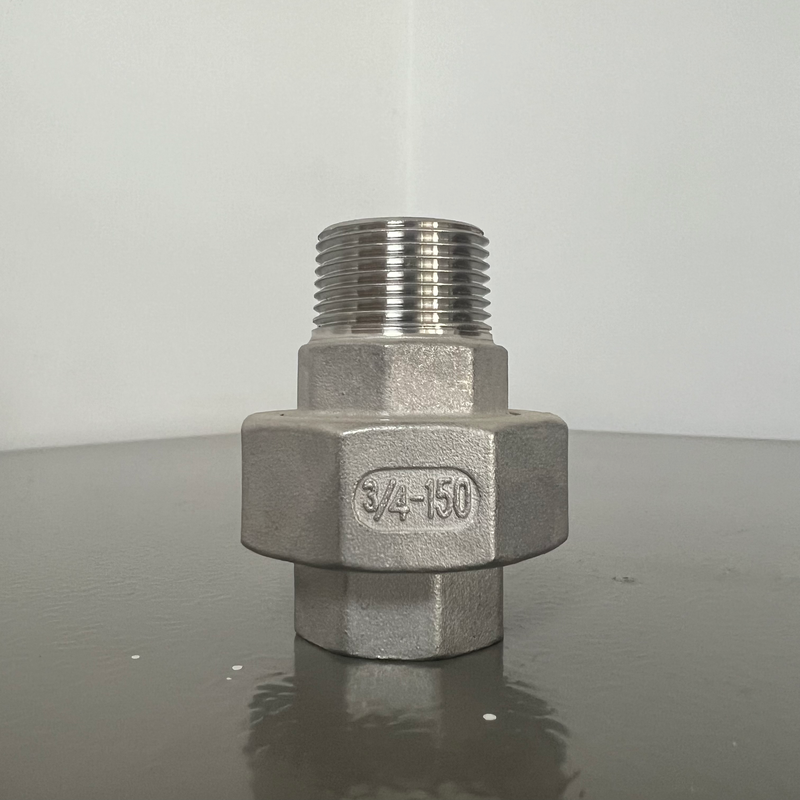
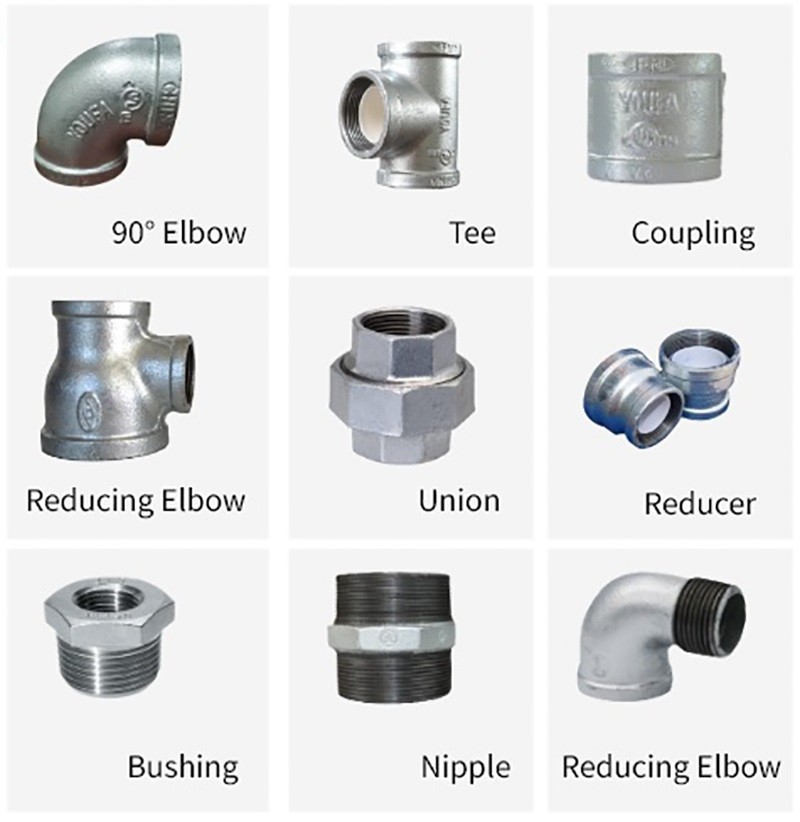
Choosing the suitable plumbing pipe fitting types is crucial for plumbing systems, pipeline industries, and gas or water supply companies. Among many options, threaded pipe fittings have earned a solid reputation for their simplicity, reliability, and cost-effectiveness. In this article, we’ll dive deep into the key advantages of threaded pipe fittings, explaining why they remain a go-to choice in many industries. 1. What Are Threaded Pipe Fittings? Threaded pipe fittings are connectors connected to two pipe sections using external (male) and internal (female) threads. They are in plumbing, natural gas distribution, fire protection systems, and industrial applications. Popular materials for threaded fittings include carbon steel, stainless steel (304/316), galvanized steel, and brass. These fittings are particularly common in smaller pipe diameters, typically under 4 inches. Easy Installation and Removal One of the significant advantages of threaded pipe fittings is the ease of installation. Unlike welding or soldering, which require skilled labor and specialized equipment, threaded fittings only use simple hand tools like pipe wrenches. No welding required: This saves labor costs and speeds up the process. Ideal for repairs: If a section needs replacement, fittings can be unscrewed and replaced without cutting the pipe. Perfect for tight spaces: Threaded plumbing pipe connectors are easier to install in confined spaces than welding. Cost-Effective Solution In terms of both labor and material costs, threaded fittings offer significant savings: Lower installation costs: Since no welding is needed, labor is quicker and cheaper. Reduced equipment expenses: Pipe thread fittings do not need expensive welding machines or protective gear. Affordable material: Common materials like galvanized steel and black iron pipe fittings are budget-friendly. They make threaded pipe fittings ideal for budget-conscious projects or temporary setups. Strong and Reliable Connections When properly installed, threaded pipe fittings provide strong mechanical connections that handle moderate to high pressures. Stainless steel pipe fittings (especially 316) offer excellent resistance to corrosion and are suitable for harsh environments. Galvanized steel fittings are ideal for outdoor or industrial applications where rust prevention is needed. Threaded connections are leak-resistant when sealed correctly with Teflon tape or pipe dope. Flexibility in Design and Application Another main advantage is flexibility: Wide range of types: There are various types of pipe fittings available—elbows, tees, couplings, bushings, plugs—all in threaded options. Easy system modification: Threaded fittings are simple to expand, reconfigure, or dismantle piping systems. Compatibility: Threaded fittings work with many pipe materials, such as steel pipes, brass pipes, and even PVC (with threaded adapters). Suitable for Low to medium-pressure systems Threaded pipe fittings are perfect for low and medium-pressure applications: Water distribution systems Compressed air networks Natural gas supply lines Fire sprinkler systems However, welded or flanged connections are more appropriate for extremely high-pressure systems or added safety-critical installations. Minimal Maintenance Needs With proper installation and sealing, threaded pipe fittings are durable and require little maintenance: Periodic checks: Inspect for leaks or corrosion. Quick fixes: Usually address any issue without extensive downtime or specialized equipment。 They make threaded fittings an excellent choice for systems where low maintenance is a priority. 2. Best Practices When Using Threaded Pipe Fittings While threaded fittings have many advantages, here are a few tips for best results: Use thread sealant: Always apply Teflon tape or pipe thread sealant for a leak-proof joint. Avoid over-tightening: This can crack fittings or deform threads. Choose the right material: Use stainless steel or brass instead of black iron for corrosive environments. 3. Conclusion Threaded pipe fittings offer an unbeatable combination of simplicity, affordability, and reliability. Whether setting up a home water system, designing an industrial gas pipeline, or maintaining a commercial building’s fire protection network, threaded fittings are a wise choice. Choosing high-quality fittings—like stainless steel couplings, galvanized steel connectors, or black pipe fittings—from a reliable supplier can ensure long-lasting performance. If you’re looking for efficient, cost-effective, and flexible pipe connection solutions, threaded pipe fittings are worth considering. Need top-quality threaded fittings at factory-direct prices? We are an experienced manufacturer offering a full range of pipe connectors with fast delivery and customization options. Contact us today to get a free quote!
Appearances and Benefits of All Kinds of Pipe Ends
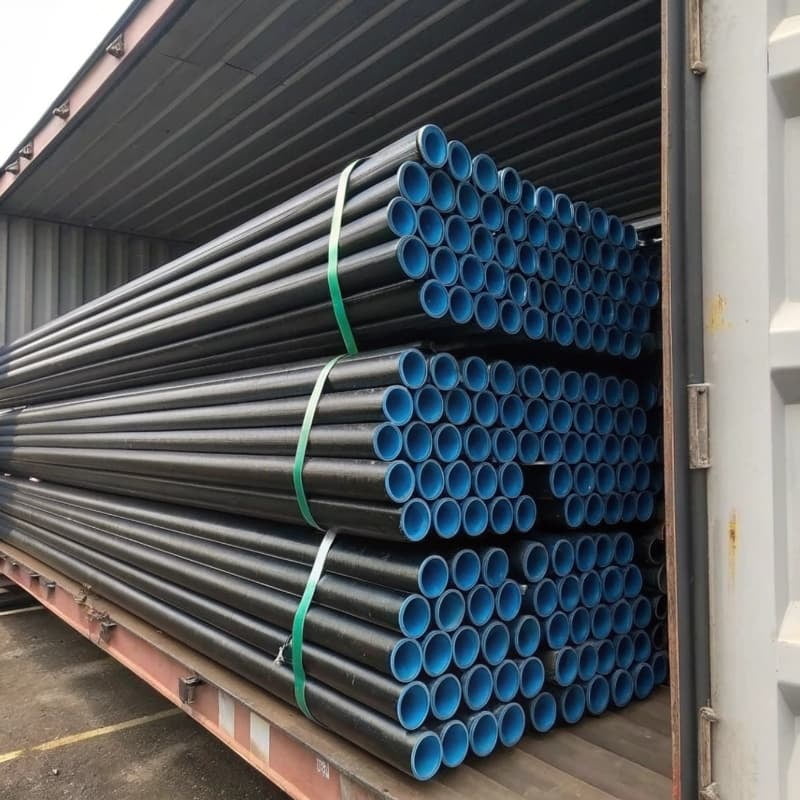
Threaded End The threaded end is the end of pipes that have male threads or female threads manufactured by mechanical processing, enabling pipes to be directly connected with pipe fittings through the threaded end. The threaded end is gradually tightened to achieve a seal and lock on the connection. The thread connection is fast and is commonly used in America, the Middle East, Southeast Asia, and other countries. Types of Threaded Ends Male Thread Threads are processed on the outside. The male threaded pipe is used with female pipe fittings or valves. Female Thread Threads are processed on the inside. The female pipe thread is suitable for connecting with a male pipe connector. Thread Standards NPT (American Taper Pipe Thread): ANSI/ASME B1.20.1 Taper: 1:16, sealing achieved by extrusion, mostly used in industrial pipelines. BSPT (Imperial taper Pipe Thread): BS 21 / ISO 7-1 Conical shape, tight, common in Europe/the Middle East. BSPP (Imperial Parallel Thread): ISO 228 It needs to be sealed with a sealing ring or gasket. Advantages of Threaded Ends Installation without welding; Reliable sealing, especially NPT and BSPT tapered thread; It can be installed and removed repeatedly for examination and maintenance. Highly cost-effective. Plain End Pipe Plain end is a smooth end without threaded, grooved, or flanged treatment. Typically, the end face is cut, deburred, and chamfered or beveled as necessary to facilitate welding, fitting, or direct insertion into the pipe fitting. Advantages of Plain End Simple construction and lower process cost; It is easy to carry out bevel welding or joint customization according to the on-site process in the future. Strong compatibility, convenient for stock management. Limits The plain end needed additional processing, which increased installation time and resources. Plain end pipe requires additional fittings for fast installation or high-pressure sealing in piping systems. Grooved End The grooved end is a pipe end processing form widely used in fast installation piping systems, and its characteristic is that a standardized annular groove is formed at the end of the pipe through mechanical rolling grooving or cutting. This groove is used in conjunction with a grooved coupling, allowing for a rapid and reliable pipeline connection through the clamping of the rubber sealing ring and the metal housing. Advantages of Grooved End Fast installation No welding, safety, smokeless, suitable for indoor or fire-free environments. Displacement is allowed, making it suitable for systems that experience thermal expansion and contraction, as well as vibration. Easy to maintain, fast removal, and replacement. Suitable for large-scale installation. High compatibility Limitations of Grooved End The supporting standard grooved coupling is required. The tank size must be strictly controlled to prevent leakage or detachment. Not suitable for extremely high-pressure working conditions (selection should be based on the coupling level). There are requirements for the ellipticity and end roundness of the pipe material (especially for grooving processing).