1. Where are Branch Pipe Fittings Needed?
Branch fittings are used when plumbing needs to divert, split, or create a secondary branch.
Pipe branch fittings transport the fluid, gas, or steam from the main line to a secondary line.
Pipe branch fittings change plumbing sizes when the branch pipe diameter is smaller than the main pipe.
They are common in industrial and commercial applications, such as petroleum plants, HVAC, municipal water supply, or fire suppression.
2. Where to Avoid Using Pipe Branch Fittings?
In a straight pipeline, a continuous single pipeline, or specific drainage, you don’t need pipe branch fittings.
Do not use branch fittings where there is no branch; do not use them in prohibited drainage and vent orientations; do not use a standard 90-degree straight tee or flat wye; do not use the wrong pipe fittings to connect the vertical pipe with the horizontal drainage pipe.
3. Types of Pipe Branch Fittings
Pipe Tee
Used to divide a pipeline into two directions or create a branch. Equal diameter or reducer.
Pipe Cross
Permits two opposing branch lines to be perpendicular to a single pipeline.
4. Difference between Branch Fittings Structure and Connection Methods
The main difference between branch fittings is their construction methods, connection methods to the main pipe, and pressure rating and stress.
Pipe Tee
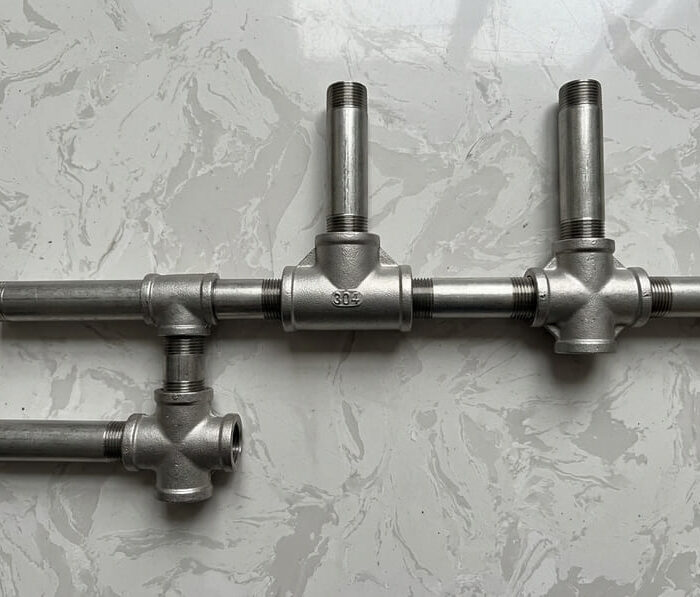
T-shaped or Y-shaped pipe fittings. They have butt welding, socket welding, or threading connections. They provide structural integrity for standard pipe systems. A pipe tee is the most common branch fitting applicable to most bifurcation systems, such as branch pipe connections in municipal water supply networks.
Pipe Cross
Pipe crosses have 4 ports, one more than a pipe tee, to divide one medium path into three paths or three medium paths into one path. A pipe cross is usually used where complex systems require division into various directions, such as pipeline distribution, large-scale pump stations, and multi-channel feeding in industrial workplaces.
Connection Methods
- Butt Welded
Welding joins adjacent ends after Edge alignment. The core advantage is uniform stress distribution, low stress concentration, and suitability for high-load applications.
- Socket Welded
The socket structure is usually shaped as a hollow cylinder. Strictly control the socket inside diameter and the connector’s outer diameter to 0.1-0.3 mm; excessive clearance causes weld porosity, while too small causes jamming.
- Threaded Connection
Threaded connection is a widely used removable fixing connection with simple construction, reliable connection, and easy installation and removal.
5. Wrong Branch Fitting Selection Consequences
Branch fitting selection requires consideration of key factors such as material, structure, pressure rating, and medium compatibility. Different applications have specific requirements. Materials and structure directly influence applicability. Stainless steel is used for corrosive media. insufficient pressure rating or incompatible medium may cause system breakdown.
6. FAQ
- When plumbing needs an additional diversion path, how do you choose branch fitting types?
In plumbing layout construction, pipe branch fittings are a core hub to achieve multi-channel transport and branch integration. They can complete a single-pipe shunt, combine multiple pipes, and meet requirements in various applications. This type is a pipe tee. Commonly available types include equal-diameter and reducer types, and materials such as carbon steel and stainless steel.
- How to select specifications?
Selecting branch fittings requires careful consideration of diameter match, pressure rating, and end to avoid leaks or uneven flow. Steel pipe fittings are better for high-pressure systems; plastic fittings are better in acidic or alkaline environments.
- Before you get a quote, what message do you need to provide?
Please provide the specific product name, pipe tee, pipe cross, or others. If you are not sure, drawings is ok. Sizes, connection types (e.g., NPT threaded), materials like stainless steel, and quantity.