
Common Branch Pipe Fittings and Roles
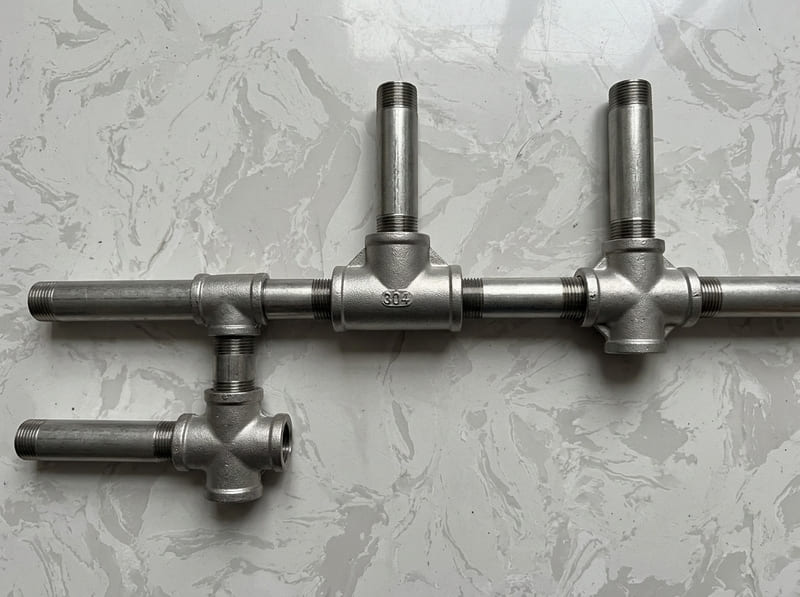
1. Where Are Branch Pipe Fittings Needed? Branch fittings are used when plumbing needs to divert, split, or create a secondary branch. They transport the fluid, gas, or steam from the main line to a secondary line. They change plumbing sizes when the branch pipe diameter is smaller than the main pipe. They are common in industrial and commercial applications, such as petroleum plants, HVAC, municipal water supply, or fire suppression. 2. Where to Avoid Using Pipe Branch Fittings? In a straight pipeline, a continuous single pipeline, or specific drainage, you don’t need pipe branch fittings. Do not use them where there is no branch; do not use them in prohibited drainage and vent orientations; do not use a standard 90-degree straight tee or flat wye; do not use the wrong pipe fittings to connect the vertical pipe with the horizontal drainage pipe. 3. Types Pipe Tee Used to divide a pipeline into two directions or create a branch. Equal diameter or reducer. Pipe Cross Permits two opposing branch lines to be perpendicular to a single pipeline. 4. Difference between Branch Fittings Structure and Connection Methods The main difference between branch fittings is their construction methods, connection methods to the main pipe, and pressure rating and stress. Pipe Tee T-shaped or Y-shaped pipe fittings. They have butt welding, socket welding, or threading connections. They provide structural integrity for standard pipe systems. A pipe tee is the most common type applicable to most bifurcation systems, such as branch pipe connections in municipal water supply networks. Pipe Cross Pipe crosses have 4 ports, one more than a pipe tee, to divide one medium path into three paths or three medium paths into one path. A pipe cross is usually used where complex systems require division into various directions, such as pipeline distribution, large-scale pump stations, and multi-channel feeding in industrial workplaces. Connection Methods Butt Welded Welding joins adjacent ends after Edge alignment. The core advantage is uniform stress distribution, low stress concentration, and suitability for high-load applications. Socket Welded The socket structure is usually shaped as a hollow cylinder. Strictly control the socket inside diameter and the connector’s outer diameter to 0.1-0.3 mm; excessive clearance causes weld porosity, while too small causes jamming. Threaded Connection Threaded connection is a widely used removable fixing connection with simple construction, reliable connection, and easy installation and removal. 5. Wrong Branch Fitting Selection Consequences Branch fitting selection requires consideration of key factors such as material, structure, pressure rating, and medium compatibility. Different applications have specific requirements. Materials and structure directly influence applicability. Stainless steel is used for corrosive media. insufficient pressure rating or incompatible medium may cause system breakdown. 6. FAQ When plumbing needs an additional diversion path, how do you choose branch fitting types? In plumbing layout construction, they are a core hub to achieve multi-channel transport and branch integration. They can complete a single-pipe shunt, combine multiple pipes, and meet requirements in various applications. This type is a pipe tee. Commonly available types include equal-diameter and reducer types, and materials such as carbon steel and stainless steel. How to select specifications? Selecting branch fittings requires careful consideration of diameter match, pressure rating, and end to avoid leaks or uneven flow. Steel pipe fittings are better for high-pressure systems; plastic fittings are better in acidic or alkaline environments. Before you get a quote, what message do you need to provide? Please provide the specific product name, pipe tee, pipe cross, or others. If you are not sure, drawings is ok. Sizes, connection types (e.g., NPT threaded), materials like stainless steel, and quantity.
The Difference Between Welded And Seamless Pipe Nipples
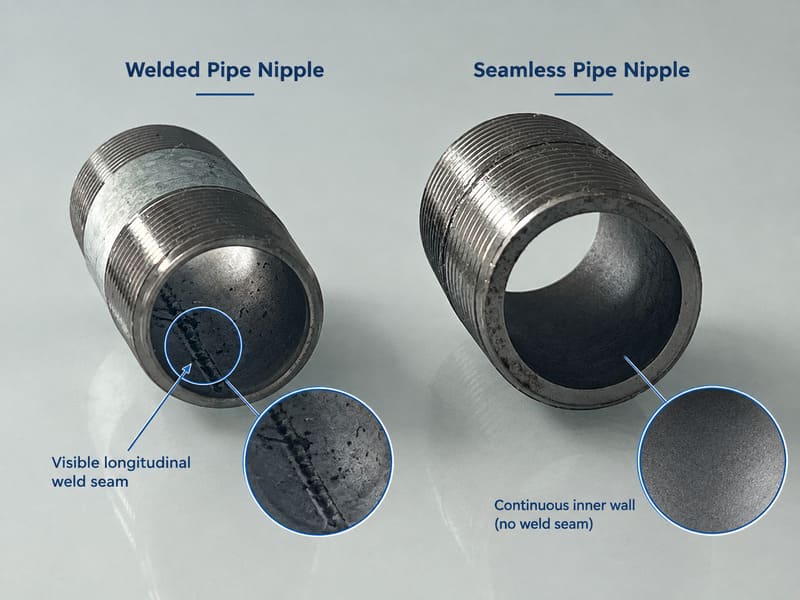
Pipe nipples are manufactured from seamless or welded steel pipe. Therefore, the base pipe manufacturing method affects the construction, performance, cost, and applications of pipe nipples. When comparing seamless vs. welded pipe nipples, the main difference is how the base pipes are manufactured. Welded pipes are made from steel strip or plate, welded after curling and forming. Seamless pipe is made from a solid billet and is pierced/formed without a longitudinal weld. 1. Welded Pipe Nipple Welded pipe nipples are made from flat pieces of carbon or stainless steel. The flat material is rolled into a cylindrical shape and then welded along the seam to create the pipe. We produce stainless steel, brass, galvanized steel, and black steel pipe nipples. Standard sizes range from 1/8″ to 8″, with custom sizes available. Thread types include: NPT, BSPP, BSPT. Key Characteristics: Cost-effective: Welded pipe nipples are usually more economical than seamless when permitted welded construction meets applicable specifications and use requirements. Available in Different specifications: Sizes, wall thickness, materials, lengths, and threads can be specified based on applications and purchasing requirements. 2. Seamless Pipe Nipple Seamless pipe nipples are made of seamless pipe. Seamless pipe is formed from a solid steel billet through piercing and hot or cold rolling. Then, the finished pipe is cut to the required length and threaded to make a pipe nipple. Key Characteristics: No longitudinal weld seam: Seamless pipe is the base pipe for seamless pipe nipples and has no longitudinal weld seam. They are usually chosen when seamless construction is specified or preferred for the service conditions. 3. Seamless vs. Welded Pipe Nipples Appearance: Seamless pipe nipples: Their base pipes have no visible longitudinal seams. Welded pipe nipples: The base pipe has a longitudinal weld seam, although the seam may not be clearly visible depending on the manufacturing process and finish. Pressure and Service Conditions: The pressure resistance of seamless and welded pipe nipples does not depend on welding alone. The pressure capability also depends on material grade, OD, wall thickness, temperature, specifications, and design requirements. Cost and Performance: Welded pipe nipples are usually more economical because welded pipe manufacturing costs are lower than those of seamless pipe. Seamless pipe nipples are usually more expensive because seamless pipes require a different manufacturing process and are commonly used where seamless construction is required. While cost should be considered with applicable specifications, use conditions, materials, sizes, and project requirements, do not base decisions only on lower cost and higher strength. Applications: Seamless pipe nipples are commonly selected where seamless construction is needed, depending on applicable materials and requirements. Welded pipe nipples can also be used in pressure applications when applicable specifications and design requirements permit welding. This includes water, gas, and heating systems. Feature Welded Pipe Nipple Seamless Pipe Nipple Base pipe Welded steel pipe Seamless steel pipe Longitudinal weld seam Present in the base pipe None Construction Formed and welded Produced from solid billet Cost Generally more economical Generally higher Pressure capability Depends on material, wall thickness, specification, and design Depends on material, wall thickness, specification, and design Selection Suitable where welded construction is permitted Selected where seamless construction is specified or preferred Typical materials Carbon steel, stainless steel Carbon steel, stainless steel; red brass for applicable products Standards Applicable nipple and pipe/material specifications Applicable nipple and pipe/material specifications 4. Specifications Materials: Stainless steel, red brass, galvanized steel, and black steel pipe nipples. Pipe Nipple Standards: ASTM A733 is applicable for seamless and welded carbon steel pipe nipples and stainless steel pipe nipples. Applicable Materials Specifications: ASTM A53, ASTM A106, ASTM A312, and ASTM B43. Depending on the materials, construction, and requirements. Standard Sizes Range: from 1/8” to 8“, with custom sizes available. Threaded Types: NPT, BSPP, BSPT. 5. Conclusion Understanding the difference between welded and seamless pipe nipples helps buyers select the right products. The choice should depend on the required materials, sizes, wall thickness, threading, standards, pressure and temperature conditions, and project requirements. Welded pipe nipples are an economical and efficient choice when welding is permitted, while seamless pipe nipples are usually selected when seamless construction is specified or preferred. Hebei Sanvo is a Chinese pipe nipple manufacturer and supplier for bulk orders only, specializing in threaded pipe nipples, pipe couplings, and stainless steel pipe fittings. We offer carbon steel, stainless steel, galvanized steel, and other materials according to customer requirements If you need pipe nipples, whether specific materials, sizes, threaded, or standard, contact us with your requirements.
Pipe Coupling vs Union: What’s the Difference?
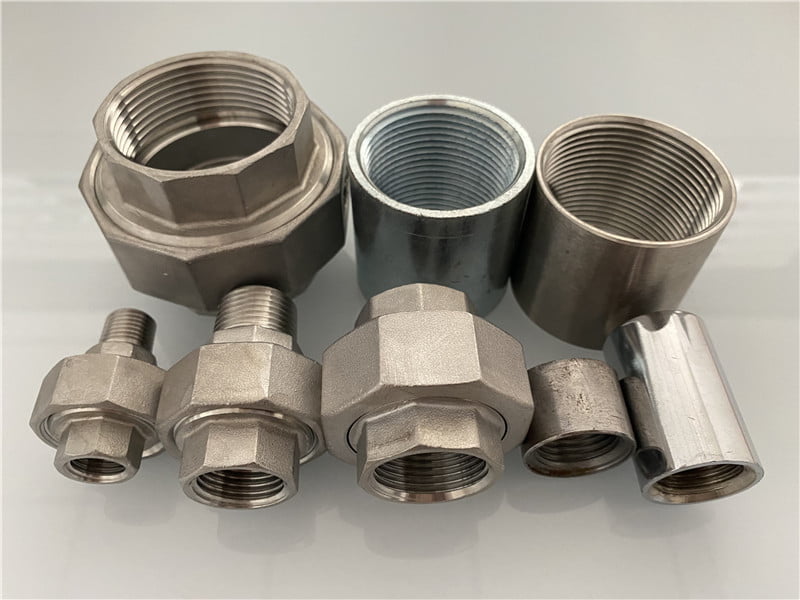
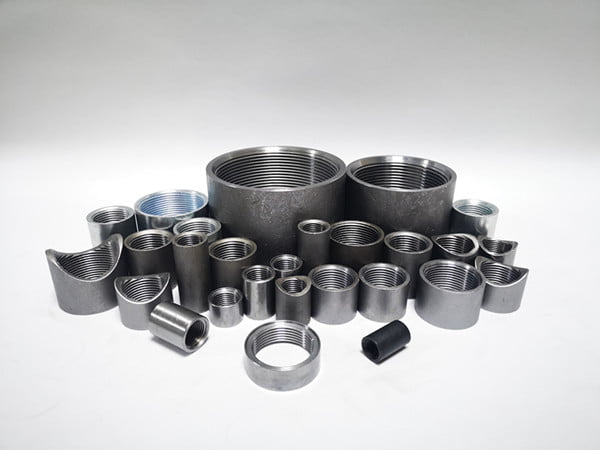
Pipe coupling vs union? When faced with a project, many people are confused about which is more suitable. Both unions and couplings connect piping, while a plumbing union fitting (also called a pipe union fitting) is designed for easy installation with a union nut. A coupling is a short pipe with female threads that extends the pipeline. Couplings provide a strong, permanent connection. Piping unions can be taken apart whenever needed for maintenance or replacement. They are reusable. So, which one should you use? Use a coupling when you need a permanent, fixed connection that won’t be disassembled. Choose a union if disassembly or maintenance is frequent. 1. What is A Pipe Coupling? A pipe coupling, also known as a pipe coupler, is a short piece of pipe used as a connector in plumbing through a threaded connection. The threaded connection is sealed. Couplings are mainly used to extend pipelines when the pipeline is not long enough. We provide couplings ranging from 1/8 inch to 12 inches and can customize them. Plumbing couplings are designed for strength and permanence, making them ideal for applications that are not expected to be frequently removed. Materials Carbon steel: galvanized and black coatings are chosen; stainless steel, PVC, and CPVC. Connection methods Threaded connections, welding, glue. Threaded connections are common and are the easiest. Welding is stronger and more permanent, but not easily removable. Glue is for PVC pipe coupling. Manufacturing standards ASME B1.20.1, DIN 2986, BS 10241. Manufacturing process Plumbing couplings are usually produced by forging. Forged steel couplings provide higher strength for high-pressure applications. Application Pipe couplings are convenient in civil construction, industry, agriculture, and other fields. 2. What Is A Pipe Union? A pipe union fitting (also called a threaded union) is a popular pipe connector because it can be easily installed and disassembled. It mainly consists of three parts: the nut and two tail pieces (top and bottom). Threaded unions are used at the ends of valves, water meters, and other pipelines. A pipe union serves as a convenient disconnect point for maintenance. It is a versatile pipe union fitting. Material Stainless steel threaded unions are common due to applications requiring high-pressure resistance, along with plastics like PVC and malleable iron. Connection forms Threaded is the most common connection; it makes installing and removing the union easier. Socket welding involves inserting a steel pipe into a socket for welding. Threaded unions connect with others through different threads, such as a male thread that connects with a female thread. Therefore, threaded unions are more convenient and are particularly popular for their ease of use in many applications. Manufacturing standards ASME B16.11. Definition A threaded union is a pipe connection by thread, the most common type of pipe fitting. The threaded union simplifies pipeline connections, allowing for easier disassembly and replacement. Type Threaded unions have M×F and F×F threads, which are common types; their two ends have equal diameters. Features of Threaded Union A threaded union is the most versatile type of pipe union, combining quick assembly with reliable sealing. Its threaded design allows direct screw-in connections without welding – ideal for maintenance-prone systems. Key Features of Threaded Pipe Unions and Plumbing Union Fittings Modular Design Consists of three reusable components: female threaded union ends, a central nut, and a sealing surface. Enables disassembly by loosening the nut while keeping pipes stationary (critical for cramped spaces). Standardized Threaded Union Dimensions Follows ASME B16.11 for pressure ratings (Class 2000 to 6000) and ANSI B1.20.1 for thread specs (NPT/BSPP). Common sizes: 1/8 to 4 inches. Plumbing Union Fittings Connection Types: Both ends have internal threads, or one end is female-threaded, and the other is male. 3. Pipe Coupling VS Union Both pipe couplings and pipe unions are pipe fittings. The basic difference between a coupling and a union is that a coupling is a permanent fitting after installation; a piping union can be easily removed at any time. Use couplings to extend pipelines; use unions for components that require frequent maintenance, such as valves and radiators. For larger diameters, flanges are preferred. Plumbing couplings have threaded, butt-welded, and socket couplings, while pipe unions have threaded and socket unions. Unlike couplings, pipe unions can be reused. Pipe unions are suitable for low-pressure applications, while pipe couplings are suitable for high-pressure applications. Where they need to be removed later, use a pipe union; use plumbing couplings where not needed. This is a reason why the ends of valves and water pumps should always use pipe union fittings. 4. Advantages and Disadvantages Couplings are durable, leak-resistant connections for high-pressure systems; once removed, they cannot be reused. Unions can be removed easily, making maintenance and part replacement easy. The connection method provides greater flexibility. However, it is less robust under high pressure or strong vibrations than some fixed connection types. Plumbing Connector Advantages Disadvantages Coupling Simple, compact, strong, cheaper Not conducive to disassembly at any time Union Easy to disconnect and reconnect, ideal for repairs Bulkier, a bit more expensive 5. Industry Applications: Where Are They Used? Both piping couplings and unions are common in various industries, but their specific placement differs. We said threaded couplings cannot be removed easily and reused, but threaded unions can. Use the chart below to determine which fittings are needed. Decision Problems If the Answer is “Yes” Does this place need maintenance later? Union Does it need to connect to valves/pumps/meter? Union Does it only need to extend two pipes? Coupling Is it used in a concealed location, without maintenance later? Coupling Unions are used at the ends of equipment and maintenance interfaces, while couplings are used in piping extensions and concealed solids. Understanding these typical placements helps wholesalers anticipate customer needs based on the type of project they are undertaking. 6. Standards and Compliance Adherence to manufacturing standards is non-negotiable for buyers focused on quality and reliability. Fittings manufactured to standards like ASME B16.11 ensure consistent quality, dimensional accuracy, and specified pressure/temperature ratings. Sourcing from manufacturers who comply with these standards guarantees that the fittings will perform as expected
What Is A Pipe Nipple?
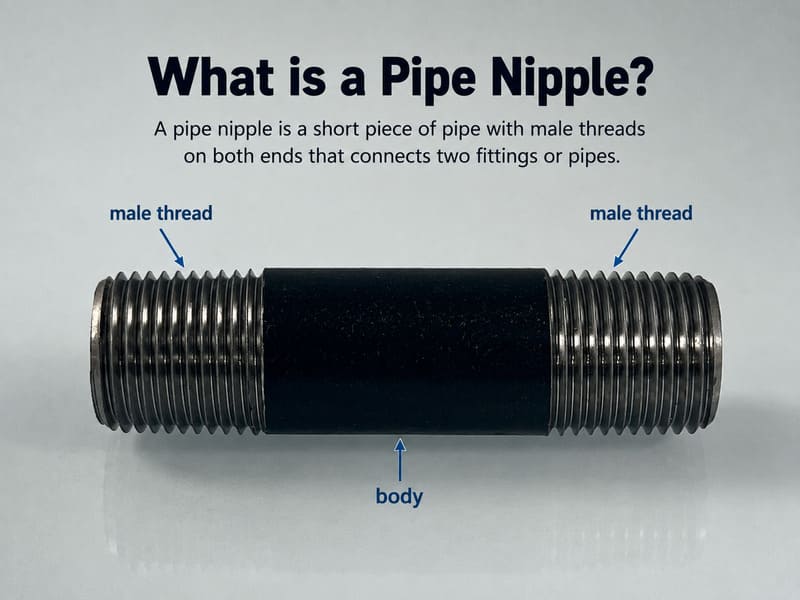
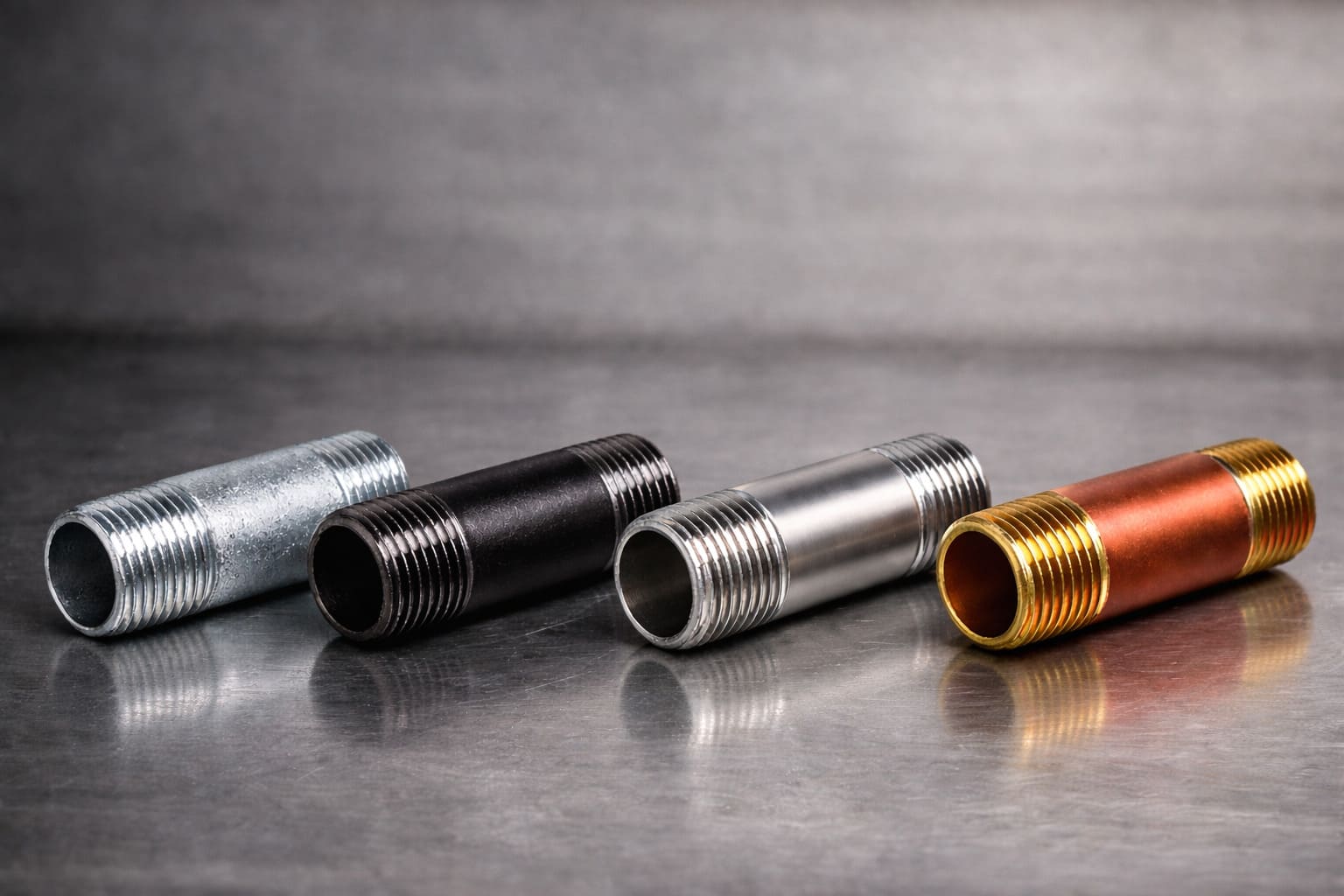
What is a Pipe Nipple? What is a pipe nipple? When talking about this, you will hear many different answers. But you only need to remember this formula: male thread + body + (male thread) = pipe nipple. Why use the parentheses? Because nipple plumbing can be divided into TOE (threaded on one end) and TBE (threaded on both ends). The pipe nipple is a short pipe with external threads (male threads) on both ends or one end, used for connections. Threaded pipe nipples can have NPT or BSP threads. Common types include stainless steel, black carbon steel, and galvanized pipe nipples. As a leading pipe nipple manufacturer, we offer a range of pipe nipples and customized sizes. 1. Types of Pipe Nipples Barrel nipples Usually called a pipe nipple, it is the most common type and has male thread ends and a smooth body in the middle. The smooth body extends the length. Welding nipple It has one end threaded and one end welded. Typically crafted from durable materials like stainless steel or carbon steel, these nipples are often used in high-pressure applications. In industrial settings, the use of welding nipples is prevalent in oil and gas pipelines, chemical plants, and various manufacturing sectors. Seamless pipe nipple In addition to their practical applications in plumbing, seamless pipe nipples are also commonly used in oil and gas industries, chemical processing plants, and HVAC systems. The length of the nipple is typically the total length of its threaded portion. Pipe nipples may have: Reducer (unequal) nipples These fittings connect pipes with differing diameters, ensuring a seamless flow while maintaining pressure integrity. The different-sized ends and threads used on nipples are BSP, BSPT, NPT, NPSM, and Metric. Hex Nipples With a hexagonal section in the middle for wrench use, constructed from robust materials, hex nipples ensure a dependable means of linking two sections of pipe, a secure seal that resists leaks and endures high pressure. Features a hexagonal section in the center, allowing easy tightening or loosening with a wrench. Close Nipple / Running Nipple They have full-body threads, enabling a close connection between two fittings screwed tightly between two female fittings, with very little of the nipple remaining exposed. An internal pipe wrench prevents thread damage. Hose Nipple There is a special style of pipe nipple called a hose nipple for connecting threaded pipes and smooth hoses. One end of the nipple has an external thread, while the other is a hose barb. The hose barb size can match the pipe connection size or be reduced properly. King nipple The king nipple has a special design: one end is a threaded connection to other female threads, and the other is a barb end to connect a hose pipe. 2. Supply Range for Pipe Nipples The working pressure of pipe nipples will vary with the size and construction of the pipe, the type and number of clamps used, clamp placement, correct clamp installation, temperature, and the product being conveyed. Pipe nipples are available in the widest variety of wall thicknesses and materials. Hebei Sanvo, a trusted supplier, offers threaded pipe nipples and seamless pipe nipples in carbon steel and stainless steel. Material Carbon steel, Stainless steel Standards ASTM A733, DIN2982, BS EN10241 Dimensions 1/8″-8″ (DN6-DN150) Finishes Black or galvanized 3. How to Install Pipe Nipple? Before, we learned about pipe nipple types, and now, we will talk about how to install them. It is not difficult; regardless of the type, the installation methods are almost the same. Tighten the thread in a clockwise direction (except for a very few types), Screw by hand first, then use a wrench or spanner to tighten it further. Note that a closed nipple requires an internal expansion wrench due to its design; the welding nipple has a welding end for welding to others. 4. Pipe Nipple Standards Hebei Sanvo exports various standards of steel pipe nipples, including carbon steel pipe nipples, stainless steel pipe nipples, welded pipe nipples, seamless pipe nipples, American standard steel pipe nipples, German standard steel pipe nipples, British standard steel pipe nipples, etc. ASTM A733 Standard Carbon Steel Pipe Nipple Material: ASTM A53/A106 Thread: ANSI/ASME B 1.20.1 Stainless Steel Pipe Nipple Material: ASTM A312 (304/316); welded or seamless Thread: ANSI/ASME B 1.20.1 DIN2982, BS EN10241 Standards DIN2982 Material: DIN2441 or DIN2440 seamless/welded pipe Thread: DIN259; DIN2999 BS EN10241 Material: BS1387 seamless or welded pipe Thread: ISO 7/1 or BS 21 5. Dimension Standards The pipe nipple has different dimension standards according to different thread manufacturing standards. Different thread types. The most commonly used types are NPT threads and BSP Threads. NPT is an American standard for tapered threads, whereas BSP is a British standard for threads. The BSP thread includes two types: the tapered BSPT and the parallel BSPP. NPT Pipe Nipple Dimension Standard BSP Pipe Nipple Dimension Standard 6. Materials Carbon nipple Carbon steel nipples usually include galvanized and black steel nipples. These are used to connect two other pipes or fittings, offering a reliable and durable solution for fluid transfer. Galvanized nipple The galvanization process, which involves coating steel with a layer of zinc, provides enhanced corrosion resistance, making these nipples ideal for use in environments prone to moisture and chemical exposure. Black pipe nipple A black pipe nipple without coating. Not resistant to corrosion and wear. Stainless nipple When selecting the stainless steel grade for your pipe nipples, it is crucial to consider factors such as the specific environment, pressure ratings, and temperature variations. Common grades like 304 and 316 are popular due to their excellent mechanical properties. 7. Material Grades of Steel Pipe Nipples Pipe nipples by Hebei Sanvo have high-quality materials: Carbon Steel ASTM A105, ASTM A53 GR. A & B, API 5L GR. B Stainless Steel ASTM A182 (304, 316), ASTM A312/A403 (TP304, TP316) Hebei Sanvo Pipes And Fittings Co., Ltd. is in Cangzhou City, Hebei Province, China. Hebei Sanvo is a Chinese manufacturer. It was engaged in producing and researching pipe nipples, pipe couplings, and stainless steel pipe
Pipe Bushing vs Reducing Coupling: What’s The Difference?
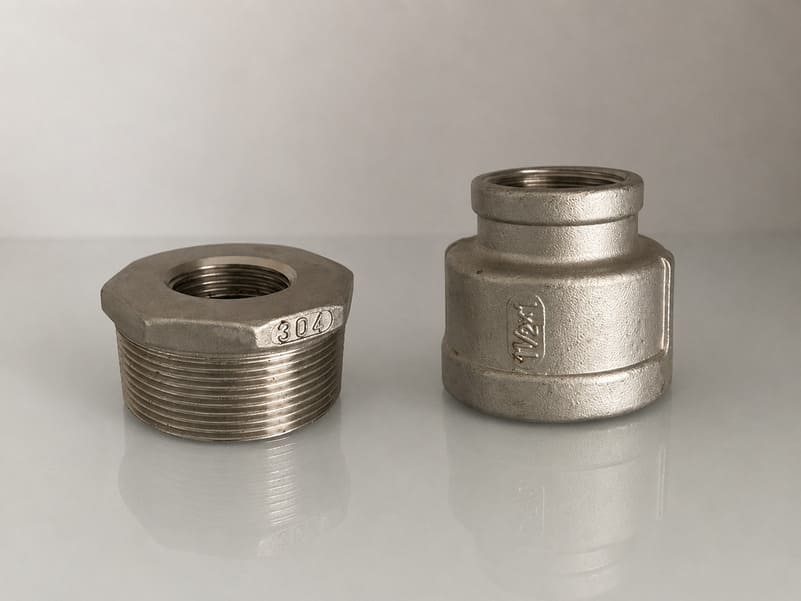
Purchasers often confuse pipe bushings and pipe reducers when buying products from us. Yes, in their function, they are similar. And they are pipe reducer fittings. The best way to distinguish them is still by appearance. A bushing has threaded ends, and a pipe reducer has plain ends. A pipe bushing normally has a male thread on the outside and a female thread on the inside, allowing it to reduce a threaded opening while maintaining a compact connection. What Is A Pipe Bushing? The pipe bushing has one male end and one female threaded end. Usually, the larger diameter is the male threaded end. Its core role is to let a large female end convert to a smaller male end. What Is A Hex Bushing? The hex bushing is a common type of bushing. What we often refer to as a pipe bushing actually means a hex bushing. A hex bushing has a hex part as the main body. So, if a product is short, has a hex part, one male end, and one female threaded end. It can basically be directly judged as a hex bushing. What Is A Pipe Reducer? The primary function of a pipe reducer is to connect pipes of varying diameters. Both ends are usually weld or socket ends. The shape of a pipe reducer looks like a trumpet. Usually, a pipe reducer is longer than a hex bushing and without a hex part. Its main role is to reduce the fluid from a large diameter to a small diameter. What is a Reducing Coupling? The reducer coupling is a type of reducer pipe fitting that has threaded ends. Reducer couplings have female threaded ends. Reducer couplings connect pipes and fittings of different sizes. Reducer Coupling & Standard Pipe Coupling Normal pipe couplings and reducer couplings have female threads. But standard pipe couplings have the same diameter, whereas reducer couplings do not. Bushing vs Reducer: Main Differences Feature Pipe Bushing Pipe Reducer Main Purpose Reduce a threaded connection Transition between different pipe sizes Typical Design Male × Female Various configurations Common Connection Threaded Threaded or welded Shape Compact Tapered or concentric Installation Usually threaded Threaded or welded Common Application Small threaded connections Industrial pipe transitions The most important distinction is that a threaded bushing changes the size of a threaded opening, while a reducer is primarily designed to create a transition between different pipe sizes. Common Purchasing Mistakes Choosing Only By Nominal Size A fitting cannot be selected based only on the two connection sizes. Always confirm: Male/female configuration Thread standard Material Connection type Assuming All Reducing Fittings Are Bushings A bushing is only one type of reducing fitting. Reducers, reducing tees, reducing couplings, and other fittings can also change connection sizes. The correct product depends on the function of the connection. Mixing Thread Standards NPT, BSPT, and BSPP should not be treated as interchangeable simply because their nominal sizes appear similar. Always confirm the required standard before production. Conclusion Bushings and reducer couplings both connect different diameters. But their designs are different. Yes, although the hex bushing and reducer coupling connect a big diameter to a small one. They have different installation environments and connection requirements. Reducer couplings are connected to two different-sized male threaded pipe fittings. Actually, it is a pipe coupling, just converted to a reducer connection. Hex bushings connect a big female end with a small male end. The correct fitting can make installation and maintenance much easier. FAQ What is the main difference between a pipe bushing and a reducer? A bushing adapts a larger female-threaded connection to a smaller threaded connection. Its hex body provides a surface for a wrench during installation. What is a hex bushing used for? A bushing adapts a larger female-threaded connection to a smaller threaded connection. Its hex body provides a surface for a wrench during installation. Is a pipe bushing a type of reducer? Yes, but its specific male-to-female threaded connection is not interchangeable with every reducer type. Can NPT and BSP bushings be connected together? They cannot be directly mixed. They have different thread profiles and specifications, so confirm the thread before ordering. Which is better, a bushing or a reducer? Neither is universally better. A bushing is for compact threaded connections. A reducer is more suitable when transitioning between different pipe sizes.
Pipe Elbow Types: Welded & Threaded Elbow Guide
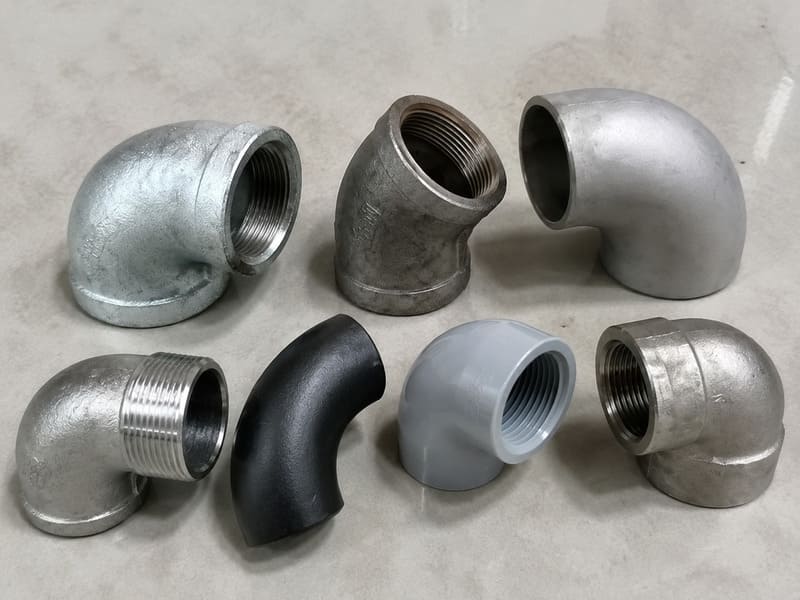
This guide provides all the information about pipe elbows, including types, pressure grades, angles, and connection methods. To distinguish between welded and threaded pipe elbows, I will introduce 3 types of welded elbows and multiple types of threaded elbows. First, let me introduce myself. We are a manufacturer with our own factory. Our main product lines include pipe nipples, couplings, and a series of stainless steel pipe fittings. We can also customize products according to your drawings and requirements. Welcome to contact us if you have any related needs. OK, let’s get started! Threaded Elbow Threaded elbow, as its name suggests, is a pipe elbow with threads on the ends to connect with other threaded pipe fittings without welding. 2 Technologies of Threaded Elbows Forged Threaded Elbow Forged threaded elbows are manufactured using forging technology. They usually have Class 2000, Class 3000, and Class 6000 pressure grades. They feature thicker wall thickness and reinforced ends. Casting Elbow Casting elbows are manufactured by casting. Normal pressure grades include 150Lb and 125Lb, with standard wall thickness. 4 Angles of Elbows 90 Degree Elbow A 90-degree elbow is the most common type. It changes the pipeline direction by 90 degrees. 45 Degree Elbow A 45-degree elbow creates less resistance to fluid flow compared with a 90-degree elbow. 60 Degree and 180 Degree Elbow 60-degree and 180-degree elbows are not commonly used in normal piping systems. 4 Thread Types NPT NPT is a tapered thread. The tighter it is tightened, the better the sealing effect. It is commonly used in American standard piping systems. BSPT BSPT is also a tapered thread. It is commonly used in Europe and Asia. It is not universally compatible with NPT threads. BSPP BSPP is a parallel thread. Sealing usually requires a gasket or sealing washer. NPS (National Pipe Straight) NPS is a parallel thread and is rarely used alone in elbow applications. Different Female and Male Threaded Elbows Female Elbow A female elbow has female threads on both ends. It is the most common type. Male Elbow A male elbow has male threads on both ends. It is less common and usually used for special applications. Street Elbow A street elbow has one male end and one female threaded end. The male end can be directly inserted into another female threaded fitting without requiring an additional threaded fitting. It is commonly used where installation space is limited. Special Type Reducing Elbow A reducing elbow has two different sizes on both ends. It changes the pipeline direction while also reducing or increasing the pipe diameter. Types of Welded Elbows Butt Weld Elbow A butt weld elbow, also called a welded pipe elbow, has beveled ends on both sides and a smooth welded body. It provides smooth fluid flow, higher sanitary performance, high strength, and resistance to high pressure and high temperature. It is commonly used for large nominal pipe sizes. Socket Weld Elbow The end of a socket weld elbow is similar to the rim of a cup, where the pipe is inserted into the socket and welded. It provides fast and easy installation and is suitable for high-pressure piping systems with small nominal sizes. Socket weld elbows use an insertion connection and are suitable for smaller nominal sizes because they are quick and easy to weld. Butt weld elbows use end-to-end welding and are suitable for large nominal sizes, high pressure, high temperature, and applications with higher sanitary requirements. Flanged Elbow The body of a flanged elbow is similar to a butt weld elbow, except that it has two flanges on both ends. A flanged elbow does not require welding. Instead, it connects and seals through bolts and gaskets. The biggest advantage is that it can be removed easily without cutting the pipeline. It is convenient for applications that require frequent replacement and maintenance. Type Connection Method Removal Socket Weld Pipes are inserted into the ends of elbows and welded. Cannot be removed. The connection is sealed and requires cutting for removal. Butt Weld Elbows and pipes are aligned and welded from end to end. Cannot be removed. The connection is sealed and requires cutting for removal. Flanged Two flange pieces are connected with the elbow in the middle and locked with bolts. Can be removed easily by simply loosening the bolts.