What Is an MTC, and Why Does It Matter?
A Material Test Certificate (MTC) verifies pipe fittings meet mechanical and chemical standards.
Without a valid MTC, you have no traceable evidence that the material in your hands is what was ordered.
For any regulated application, this is a contractual and safety requirement.
Projects typically require MTCs issued by the manufacturer’s independent inspection department.
At a higher level, MTC also requires a third-party witness's signature.
Step 1: Check That the MTC Contains All Required Fields
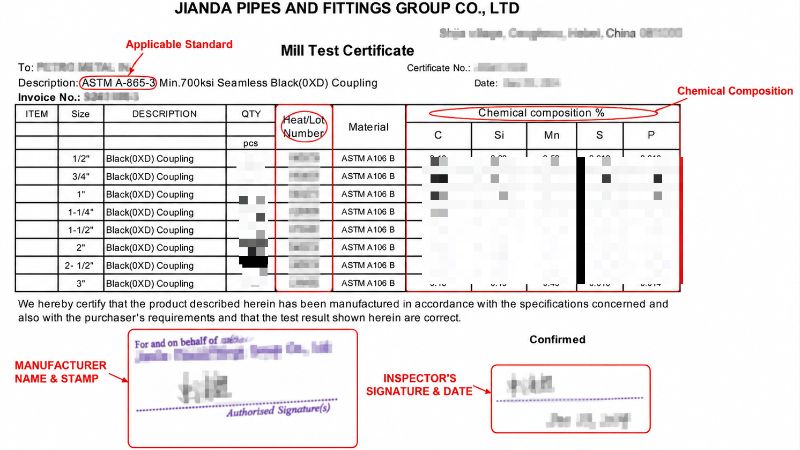
A legitimate MTC should clearly state the following:
-
Heat/Lot Number
-
Chemical Composition
-
Applicable Standard
-
Product Description
-
Manufacturer Name and Stamp
-
Inspector's Signature and Date
Step 2: Cross-Check the Heat Number Against the Physical Marking
Every fitting should have a heat number stamped or stenciled on the product itself. This number must match the heat number on the MTC.
This is one of the most overlooked checks in incoming inspection.
Suppliers sometimes provide certificates from different batches to hide testing omissions or failures.
What to do:
-
Physically inspect a sample of fittings from the shipment
-
Record the heat numbers marked on the fittings
-
Confirm they correspond to the heat number listed on the MTC
-
If numbers do not match, reject the lot until an explanation is provided in writing
Step 3: Look at the Test Data
Legitimate test results show actual measured values. For example:
| Property | Standard Minimum | What a Suspicious MTC Looks Like |
|---|---|---|
| Tensile Strength | 415 MPa min | Exactly 415 MPa |
| Yield Strength | 240 MPa min | Exactly 240 MPa |
| Elongation | 22% min | Exactly 22% |
Legitimate test results show actual measured values. For example:
Uniform results at the minimum limit suggest manual entry rather than actual data.
Real lab results have natural variation.
Request the original mill test report to audit for suspicious data.
Step 4: Verify the Certificate Format Matches the Required Level
Many Chinese suppliers use the phrase "3.1 certificate" loosely. Before accepting the document, confirm:
-
Is the certificate issued on the manufacturer's official letterhead?
-
Does it carry a separate QC department stamp distinct from the production department?
-
If 3.2 is required, is there a third-party inspector's countersignature (SGS, Bureau Veritas, TÜV, Intertek, etc.)?
A certificate signed only by the sales manager or factory director does not qualify.
Step 5: Request Third-Party Inspection for High-Value or High-Risk Orders
For critical or large orders, appoint an independent inspection agency to witness testing.
For critical or large orders, appoint an independent inspection agency to witness testing.
Witness mechanical/chemical testing, verify heat numbers and MTC, and issue the report.
This report — combined with the factory's MTC — gives you a 3.2-equivalent level of confidence.
Third-party inspection costs far less than the price of failure or delay.
Common Red Flags to Watch For
| Red Flag | What It May Indicate |
|---|---|
| Test values exactly at specification limits | Data may have been manually entered |
| The heat number on MTC does not match the physical marking | The certificate may belong to a different batch |
| Certificate signed by sales or management only | Does not meet EN 10204 3.1 requirements |
| No manufacturer stamp or only a general company chop | Certificate origin cannot be verified |
| The certificate is undated or shows an implausible date | May be reused from a previous order |
| Chemical or mechanical data copied from the standard | Actual testing may not have been performed |
A Practical Pre-Shipment Checklist
-
MTC received, and all required fields are present
-
Heat numbers on MTC match physical markings on fittings
-
Chemical and mechanical test values show realistic variation (not exact minimums)
-
The certificate is signed by the QC department (not sales or management)
-
Certificate format matches the required level (3.1 or 3.2)
-
Third-party inspection report received (if applicable)
-
All documents are in the required language (English or project-specified language)
Working With Suppliers Who Get This Right
A reliable pipe fittings manufacturer will not hesitate to provide full traceability documentation.
They understand requirements and provide source mill certificates.
We supply carbon steel, brass, and stainless pipe fittings with standard full documentation.
Contact us to verify our certifications before placing an order.