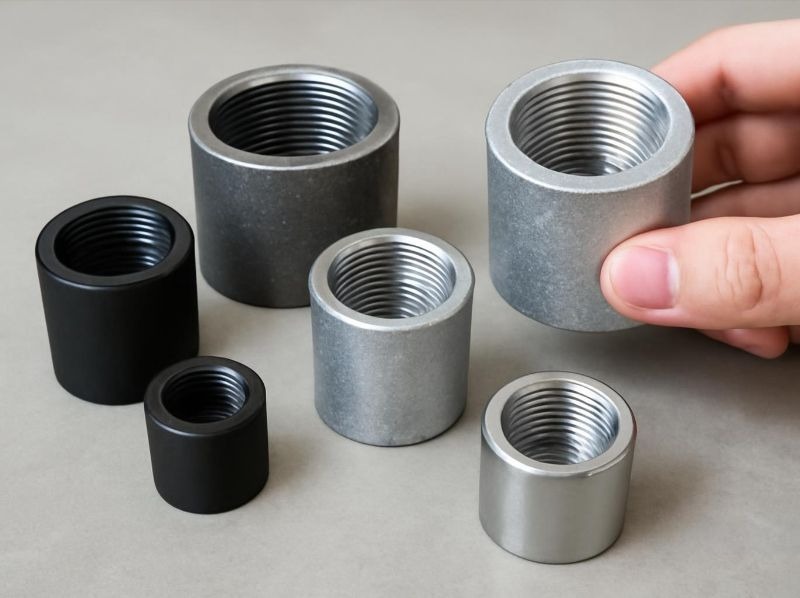
Introduction
Hex nuts are one of the most widely used fasteners.
However, selecting the wrong type causes installation failures, safety risks, and costly rework.
Therefore, understanding the key selection parameters is essential.
We supply stainless steel hex nuts and a full range of pipe fittings worldwide.
We provide technical support to specify the correct product for every application.
This guide covers everything you need to know.
It explains common nut types, material grades, thread standards, size selection, and the most frequent buying mistakes we see in the field.
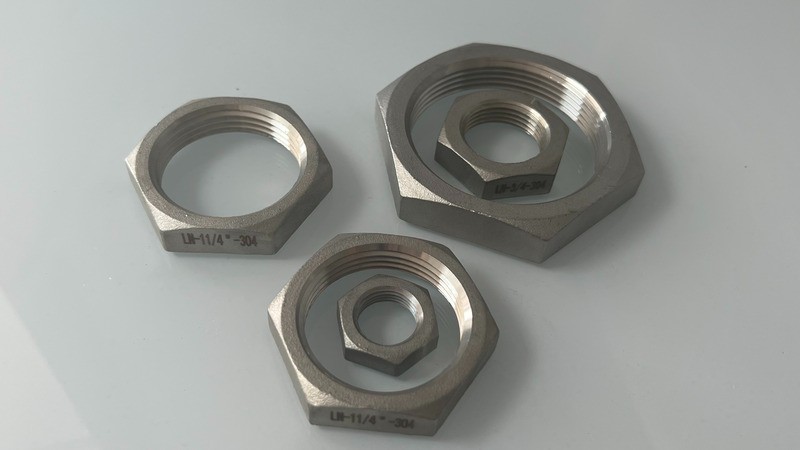
Common Types of Hex Nuts
Not all hex nuts are the same. Therefore, choosing the correct type depends on your load requirements, installation method, and application environment.
| Standard Hex Nut | ASME B18.2.2 / DIN 934 | The most common type of general fastening. Suitable for most structural and mechanical applications. Available in a wide range of sizes and materials. |
| Heavy Hex Nut | ASME B18.2.2 / ASTM A563 | Larger bearing surface than standard hex nuts. Used in structural steel, flange bolting, and high-load applications. Common in ASTM bolt and nut assemblies. |
| Nylon Insert Lock Nut | DIN 985 / ISO 7042 | Contains a nylon collar that resists vibration loosening. Ideal for equipment subject to dynamic loads. However, not suitable for temperatures above 120°C. |
| Flange Hex Nut | DIN 6923 / ISO 4161 | Integrated flange distributes load over a wider surface area. Therefore, no separate washer is needed. Common in automotive and structural applications. |
| Coupling Nut (Hex) | ASME B18.2.2 | A long hex nut is used to join two threaded rods end-to-end. For example, commonly used in threaded rod extensions and anchor bolt assemblies. |
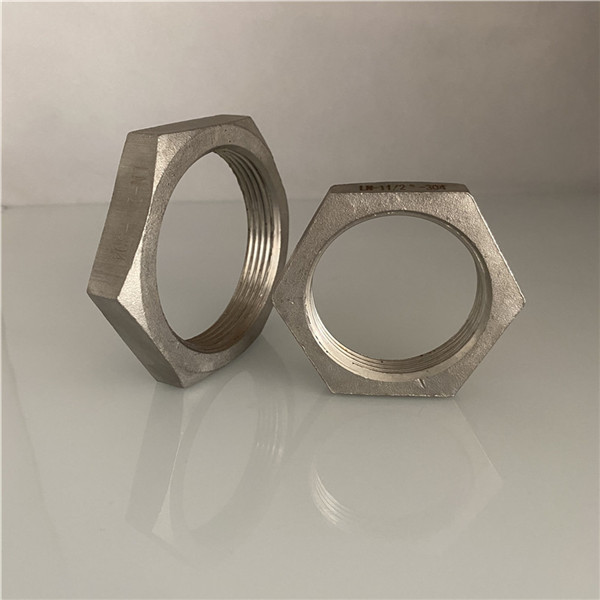
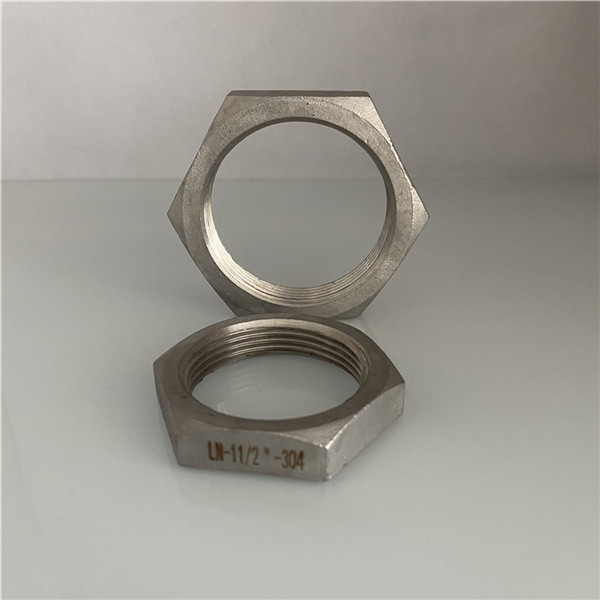
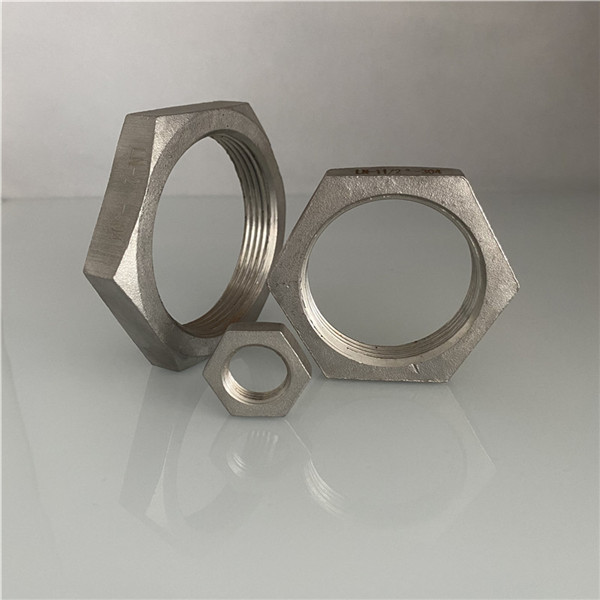
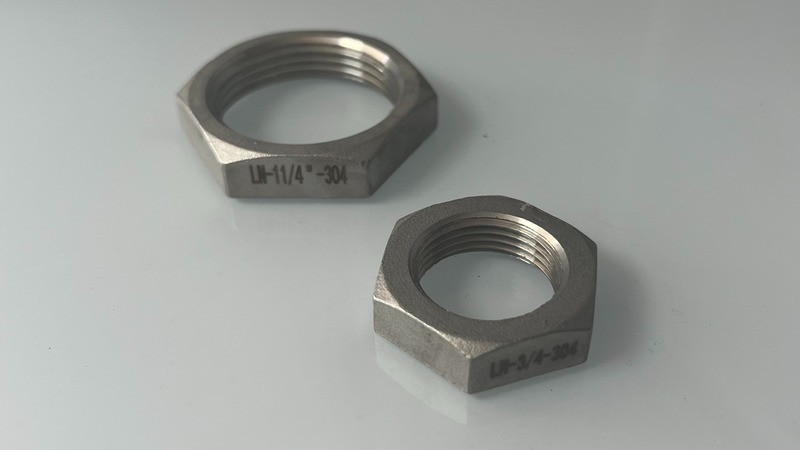
| Jam Nut (Thin Hex Nut) | DIN 439 / ISO 4035 | Thinner than a standard hex nut. Used as a locking nut against a full nut, or in applications with limited axial space. Not for primary load-bearing use alone. |
Procurement tip: When sourcing hex nuts in bulk, always confirm whether the application requires standard or heavy series.
For example, ASTM A193 stud bolts require ASTM A563 heavy hex nuts — standard hex nuts do not meet the specification.
Materials: Choosing the Right Grade
Material selection is the most critical decision when specifying hex nuts. In addition, it directly affects corrosion resistance, tensile strength, and service temperature range.
| Material | Grade / Standard | Key Properties | Typical Applications |
|---|---|---|---|
| Carbon Steel | ASTM A563 Gr. A/C/DH ISO 4032 Cl. 8 | High strength, cost-effective, requires coating for corrosion protection | Structural steel, general mechanical assembly |
| Stainless Steel 304 | ASTM F594 Gr. 8 ISO 4032 A2-70 | Good corrosion resistance, non-magnetic, moderate strength | Food processing, water treatment, and general outdoor use |
| Stainless Steel 316 | ASTM F594 Gr. 8 ISO 4032 A4-70 | Superior corrosion resistance, especially to chlorides | Marine, chemical processing, coastal environments |
| Duplex SS 2205 | ASTM A182 F51 | High strength + high corrosion resistance, chloride SCC resistant | Offshore, desalination, subsea pipelines |
| Alloy Steel | ASTM A194 Gr. 2H / 4 | Very high strength, heat-resistant | High-pressure flanges, pressure vessels, and petrochemical |
| Brass / Bronze | ASTM B16 / B98 | Excellent corrosion resistance, non-sparking | Plumbing, electrical, and explosive environments |
We recommend stainless steel hex nuts (Grade 316) for any application involving moisture, chemicals, or outdoor exposure. However, for purely structural applications with protective coatings, carbon steel hex nuts remain the most cost-effective choice.
Important: Stainless steel hex nuts and carbon steel bolts should not be mixed in high-stress assemblies. Galvanic corrosion occurs when dissimilar metals contact each other in the presence of an electrolyte. Therefore, always match nut and bolt materials whenever possible.
Size Selection: Key Parameters to Specify
When ordering hex nuts, providing only a nominal diameter is not sufficient. We require the following parameters to fulfill orders accurately.
- Nominal diameter and thread pitch — e.g. M16 x 2.0 or 5/8-11 UNC
- Nut series — standard hex or heavy hex
- Material grade — e.g. SS 316, carbon steel ASTM A563 Gr. DH
- Finish/coating — plain, hot-dip galvanized, zinc plated, passivated
- Applicable standard — ASME B18.2.2, DIN 934, ISO 4032, ASTM F594, etc.
- Quantity and packaging requirement — bulk bag, box, or individually bagged
- Certification requirement — Mill Test Report (MTR), NACE MR0175, RoHS, etc.
For importers and distributors: We strongly recommend requesting a Mill Test Report (MTR) for all stainless steel hex nuts. The MTR confirms chemical composition and mechanical properties. Therefore, it protects you from receiving substandard or mislabeled material — a growing issue in the global fastener market.
Common Buying Mistakes
We see these errors repeatedly across procurement orders. Therefore, we highlight them here to help you avoid delays, rejections, and cost overruns.
Mistake 1 — Ordering by size only, without specifying grade: "M20 stainless hex nuts" is not a complete specification. For example, without stating 304 or 316, you may receive whichever grade is in stock — which may not suit your environment.
Mistake 2 — Mixing thread standards: UNC and metric threads look similar in small sizes. However, forcing a UNC nut onto a metric bolt strips the thread immediately. Always verify the thread standard on the engineering drawing before ordering.
Mistake 3 — Ignoring the difference between standard and heavy hex: Heavy hex nuts have a larger wrench flat and thickness. Therefore, substituting standard hex for heavy hex in a bolted flange assembly violates the design specification and may fail pressure testing.
Mistake 4 — Not requesting MTR or test certificates: Counterfeit and mislabeled stainless steel fasteners are common in global supply chains. In addition, some suppliers ship carbon steel with a stainless coating. An MTR prevents this risk entirely.
Mistake 5 — Selecting 304 SS for chloride environments: 304 stainless hex nuts perform well in most conditions. However, in coastal, marine, or chemical environments with chloride exposure, 316 SS is the correct choice. 304 will pit and corrode under these conditions.
Mistake 6 — Overlooking coating compatibility: Hot-dip galvanized hex nuts require oversized threads to allow for coating thickness. Therefore, they are not dimensionally interchangeable with plain or zinc-plated nuts of the same nominal size.
FAQ
Q: What is the difference between a standard hex nut and a heavy hex nut?
A heavy hex nut has a larger wrench flat and greater thickness compared to a standard hex nut of the same thread size. Therefore, it provides a larger bearing surface and higher load capacity. Heavy hex nuts are required in structural bolting (ASTM A563) and high-pressure flange assemblies. In addition, they are the correct match for heavy hex bolts and ASTM A193 studs.
Q: When should I specify stainless steel hex nuts instead of carbon steel?
We recommend stainless steel hex nuts for any application involving moisture, outdoor exposure, chemicals, food contact, or elevated hygiene requirements. For example, water treatment plants, marine structures, coastal installations, and food processing equipment all require stainless hex nuts. However, for dry indoor structural applications, carbon steel with an appropriate coating is more cost-effective.
Q: What is the difference between 304 and 316 stainless steel hex nuts?
Both are austenitic stainless steels with good corrosion resistance. However, 316 SS contains molybdenum, which significantly improves resistance to chloride-induced pitting and crevice corrosion. Therefore, 316 stainless hex nuts are the correct specification for marine, offshore, chemical, and coastal environments. In less aggressive environments, 304 stainless hex nuts are sufficient and more economical.
Q: Can I mix stainless steel hex nuts with carbon steel bolts?
We do not recommend this combination in wet or corrosive environments. When dissimilar metals contact each other in the presence of moisture, galvanic corrosion occurs — typically accelerating corrosion of the carbon steel. Therefore, always match nut and bolt materials. In addition, consult the galvanic compatibility chart for your specific environment before specifying mixed assemblies.
Q: What certifications should I request when importing hex nuts?
At minimum, we recommend requesting a Mill Test Report (MTR) confirming chemical composition and mechanical properties. In addition, depending on your application, you may require EN 10204 3.1 or 3.2 inspection certificates, NACE MR0175 compliance for sour service, RoHS compliance for electrical applications, or PED compliance for European projects. We can provide the appropriate documentation with every order.
Q: Do you supply hex nuts to metric and imperial thread standards?
Yes. We supply hex nuts to both metric (ISO/DIN) and imperial (ASME/ASTM/UNC/UNF) thread standards. In addition, we can manufacture to customer-specific drawings for non-standard dimensions. Please provide your thread specification, material grade, and applicable standard when requesting a quote